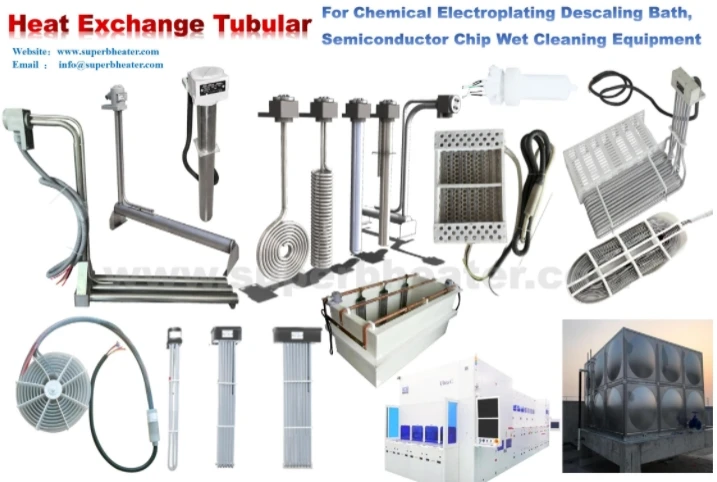
In many chemical processing facilities, a familiar design decision appears early in a project: a tank requires heating or cooling, and two viable PTFE heat exchanger configurations are available. One option places a shell and tube unit outside the vessel, circulating liquid through a pump loop. The other installs an immersion coil directly inside the tank. Both solutions are widely used, both have strong advocates, and both can perform well when correctly applied. The challenge lies not in selecting a "better" technology, but in matching the configuration to the actual operating environment.
This decision becomes easier when the operating principles and practical consequences of each design are clearly understood.
Operating Concepts and Functional Differences
A shell and tube exchanger transfers heat indirectly through an external circulation loop. Process liquid leaves the tank, passes through piping and a pump, flows across PTFE tubes inside the exchanger, and returns conditioned to the tank. Heat transfer occurs under controlled flow conditions, typically with higher velocities and more predictable turbulence.
An immersion coil, by contrast, remains inside the vessel. Heating or cooling media flows through PTFE tubing submerged in the tank contents, and heat transfer depends largely on natural convection or agitation within the vessel itself.
The difference appears simple, yet it influences nearly every performance parameter: efficiency, controllability, fouling behavior, and maintenance accessibility.
Heat Load and Process Control
For large heat duties, shell and tube exchangers generally provide superior performance. Forced circulation allows higher flow velocity over heat transfer surfaces, which significantly increases heat transfer coefficients. Temperature response is faster, and process control becomes more stable because thermal exchange occurs in a predictable hydraulic regime rather than depending on tank mixing patterns.
Immersion coils perform adequately when heat demand is moderate and temperature tolerance is relatively forgiving. In smaller tanks or batch operations, natural convection often distributes heat sufficiently, particularly when agitation exists. However, in large vessels or viscous liquids, thermal stratification may develop, causing uneven heating or cooling.
In practice, tanks below approximately 5,000 liters containing low-viscosity fluids often operate efficiently with immersion coils. As volume increases or viscosity rises, external circulation systems become increasingly advantageous.
Fouling and Cleanability
Fouling behavior frequently determines long-term reliability more than initial performance.
Shell and tube units offer significant maintenance advantages. Removable bundles permit mechanical cleaning, chemical flushing, and inspection without entering the tank. Because process liquid flows through piping, maintenance can occur while the tank remains isolated. For crystallizing, polymerizing, or particulate-laden fluids, this accessibility becomes critical.
Immersion coils present the opposite situation. Since the exchanger resides inside the tank, cleaning requires draining the vessel or manual access. In fouling service, deposits accumulate on submerged tubing and may remain unnoticed until heat transfer deteriorates significantly. Removal and cleaning can interrupt production for extended periods.
A common operational difficulty arises when immersion coils are selected for fluids prone to scale formation. Over time, performance declines while maintenance becomes increasingly disruptive. In such applications, a shell and tube exchanger with removable bundle construction provides a more sustainable solution.
Installation Space and Mechanical Simplicity
Immersion coils offer undeniable simplicity. They require no circulation pump, minimal piping, and minimal footprint outside the vessel. Installation is straightforward and capital cost is typically lower. For retrofits or crowded facilities, this simplicity can outweigh performance limitations.
Shell and tube exchangers demand additional components: pump selection, piping design, valves, and instrumentation. The mechanical system becomes more complex, requiring engineering attention to flow rate, cavitation prevention, and pressure drop management. However, the added complexity provides operational flexibility and control precision.
Facilities with limited floor space but accessible tank interiors often favor immersion coils. Plants prioritizing serviceability and operational continuity often accept the external footprint of a circulation loop.
Fluid Characteristics and Compatibility
Fluid cleanliness plays a decisive role in configuration selection.
Clean, low-solids solutions function well with immersion coils. Since fouling risk is minimal, maintenance disadvantages rarely materialize. Many plating baths, rinse tanks, and dilute chemical solutions fall into this category.
Contaminated or unstable fluids behave differently. Suspended solids, crystallizing salts, polymer precursors, and viscous mixtures benefit from controlled velocity across heat transfer surfaces. External circulation reduces localized hot spots and prevents deposition layers from forming rapidly.
In aggressive chemistries, PTFE construction protects against corrosion in both designs, but operational reliability depends more on fouling behavior than chemical compatibility.
Maintenance Access and Operational Strategy
Maintenance philosophy often determines the optimal choice as much as engineering calculations. Facilities operating continuous production lines generally prioritize accessibility and predictable service intervals. External exchangers support this approach by enabling inspection and cleaning without tank entry.
Batch facilities with infrequent maintenance cycles may accept internal coil cleaning during scheduled shutdowns. In such environments, mechanical simplicity and lower capital cost often outweigh service accessibility.
Making the Configuration Selection
Choosing between shell and tube and immersion coil configurations requires balancing thermal performance, maintenance strategy, available space, and fluid behavior rather than applying a universal rule. Small tanks with clean fluids and limited installation space frequently operate most economically with immersion coils. Large tanks, high heat loads, fouling liquids, or operations requiring rapid maintenance typically favor external shell and tube exchangers.
Careful application matching prevents many long-term operational frustrations. When the selection remains uncertain, evaluating both options with experienced equipment suppliers often reveals subtle operational considerations-maintenance logistics, pump energy consumption, or cleaning frequency-that ultimately determine the most reliable configuration.