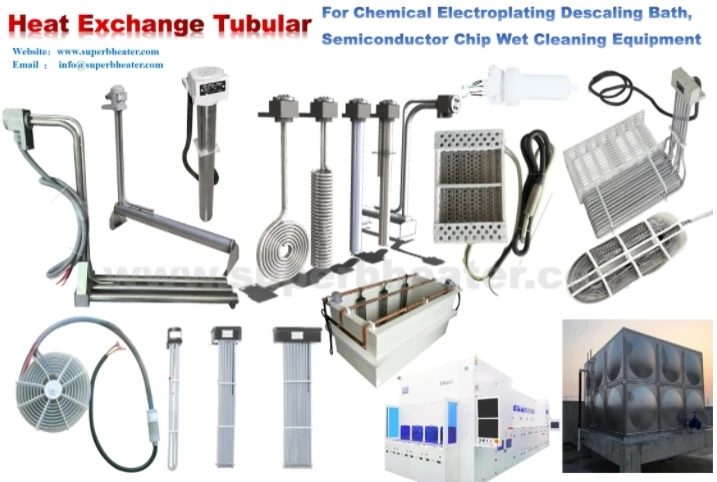
Specifying the wrong operating voltage for a PTFE immersion heater is a surprisingly common and costly mistake. A heater arrives on site, installation begins, and only then is it discovered that the facility power supply does not match the heater nameplate. The result may involve delays, emergency transformer procurement, or complete heater replacement. Because voltage selection directly determines current draw and internal element design, it is not a parameter that can be adjusted after manufacturing. Getting this fundamental specification correct is essential for safe and reliable operation.
Matching Voltage to Site Power
Voltage selection must always begin with the available power supply at the installation site. Industrial facilities around the world operate on standardized systems that vary by region. Common industrial voltages include 208V and 230V in North America, 400V systems in Europe and parts of Asia, and 460V or 480V in many heavy industrial environments. In some regions, 380V and 440V remain in use, particularly in legacy installations.
Before ordering a PTFE immersion heater, the exact nominal voltage, frequency (50 Hz or 60 Hz), and phase configuration must be confirmed from facility electrical documentation. Designing the heater to match the actual supply eliminates the need for step-up or step-down transformers and simplifies the electrical configuration.
Single-Phase Versus Three-Phase
Another critical consideration in voltage selection is whether the heater will operate on single-phase or three-phase power. Smaller heaters, typically below 5 to 10 kilowatts, often use single-phase supply. Single-phase systems are simpler and common in light industrial or laboratory environments.
For higher power applications, three-phase supply is generally preferred. Three-phase systems distribute electrical load more evenly across conductors, reducing current per phase and improving efficiency. They also minimize voltage drop in supply cables and provide smoother power delivery. For industrial tanks requiring substantial heating capacity, three-phase operation offers better electrical balance and reduced conductor size compared to equivalent single-phase systems.
As heater wattage increases, single-phase current draw can become impractically high. Excessive current requires larger conductors, heavier contactors, and more robust overcurrent protection. In such cases, three-phase configuration provides a more practical and economical solution.
Relationship Between Voltage, Current, and Power
Understanding the relationship between voltage, current draw, and power is fundamental to correct voltage selection. Electrical power is calculated as:
Single-phase:
( P = V \times I )
Three-phase (simplified):
( P = \sqrt{3} \times V \times I )
Where ( P ) is power in watts, ( V ) is voltage, and ( I ) is current.
For a fixed power requirement, increasing voltage reduces the required current. Lower current allows smaller wire gauges, reduced conductor heating, and lower line losses. In large installations, higher voltage operation can significantly reduce distribution costs and improve overall system efficiency.
Incorrect voltage connection, however, can have catastrophic consequences. In practice, a heater designed for 230-volt operation connected to a 460-volt supply will attempt to draw approximately four times its rated power, because power increases with the square of voltage in resistive heating elements. The heating element will fail almost instantly due to extreme overheating. Conversely, supplying half the rated voltage results in only one-quarter of the rated power, leading to severely reduced heating performance.
International Standards and Export Considerations
For equipment intended for international markets, voltage selection becomes more complex. Industrial voltage standards vary not only by region but sometimes within countries. North American systems commonly use 208V, 230V, 460V, or 480V at 60 Hz, while many European and Asian installations operate at 400V or 415V at 50 Hz.
When designing PTFE immersion heaters for export, one strategy is to design for the highest common industrial voltage and use local transformers where required. This approach can provide flexibility for multinational installations. However, transformer use introduces additional cost, space requirements, and energy losses. Therefore, evaluating the long-term operational environment remains critical.
Frequency compatibility must also be considered. While resistive heaters are generally less sensitive to frequency than motors, associated control components, contactors, and protective devices must match the local electrical standard.
Current Draw and Electrical Infrastructure
Beyond matching nominal voltage, evaluating the facility's electrical infrastructure is essential. Available breaker capacity, panel space, cable length, and grounding requirements all influence voltage selection. Higher voltage systems reduce current draw, which can prevent overloading existing distribution panels.
For example, a 30 kW heater operating at 230V single-phase draws over 130 amperes, which may exceed typical panel ratings. The same heater at 400V three-phase draws significantly less current per phase, simplifying protection and conductor sizing.
Electrical Configuration and Safety
Voltage selection also affects internal heater design, terminal configuration, and safety components. PTFE immersion heaters must integrate appropriate over-temperature protection, grounding provisions, and compatible control devices. Selecting the correct voltage ensures that all protective systems function within their intended parameters.
Because voltage is a fixed design attribute of the heating element, post-installation changes are rarely feasible without replacing the heater assembly. Early coordination between process engineering and electrical engineering teams prevents specification errors.
Summary
Selecting the correct operating voltage for PTFE immersion heaters requires careful evaluation of site power availability, single-phase versus three-phase requirements, current draw, and international standards. Higher voltage operation generally reduces current and improves distribution efficiency, while three-phase systems are preferred for larger loads. Incorrect voltage selection can result in immediate heater failure or unacceptable performance.
Voltage selection is a foundational electrical parameter that cannot be modified without replacing the heater. Once voltage and phase configuration are determined, the next critical decision involves distributing the total wattage appropriately across the heating surface to ensure uniform thermal performance and long service life.