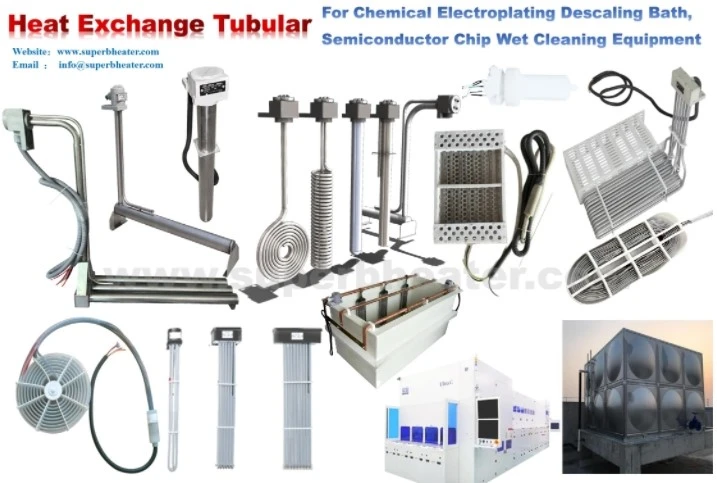
Selecting heating plate power for a chemical process tank is often reduced to one question: how many kilowatts are required? In practice, that number depends on much more than tank volume.
A 2,000-liter tank with a well-insulated structure and slow temperature rise has a very different heating requirement from the same tank exposed to continuous heat loss and a short production recovery time.
The key engineering balance is heating speed versus temperature stability and operating efficiency.
Start With the Required Heat Load
The basic energy required to raise the liquid temperature can be estimated from:
Q = mCpΔT
where m is liquid mass, Cp is specific heat capacity, and ΔT is the required temperature increase.
The heating system must also compensate for heat continuously lost through the tank wall, liquid surface, piping, fixtures, and surrounding environment:
Qtotal = mCpΔT / t + Qloss
Here, t represents the required heating time.
This relationship explains why the same chemical tank can require very different heating plate power depending on the target recovery time.
Heating Time Determines Installed Capacity
Suppose a process requires a large temperature increase within a short period. Higher heating capacity may be necessary.
However, excessive capacity creates another problem.
If the heating plate has substantially more power than the process requires, the control system may frequently switch between high output and shutdown. The result can be temperature overshoot, greater thermal cycling, and unnecessary energy consumption.
A properly selected heating plate should provide sufficient capacity for the maximum expected thermal load, while remaining controllable during normal production.
Heating Area Matters as Much as Kilowatts
Total power does not describe how aggressively heat enters the liquid.
Surface heat flux is:
q″ = Q/A
where Q is heating power and A is effective heating area.
Two heating plates can both provide 12 kW while producing very different thermal conditions if their active areas are different.
A larger heating area generally allows the same power to be distributed over a greater surface. This can reduce local temperature differences and improve heat transfer when circulation is adequate.
For corrosive chemical applications, this consideration becomes especially important when using a PTFE heating plate, because PTFE has lower thermal conductivity than common metals.
A Practical Power Selection Framework
Several operating parameters should be established before selecting the heating plate rating.
| Design parameter | Lower requirement | Higher requirement | Effect on heating plate power |
|---|---|---|---|
| Bath volume | Small | Large | Higher volume requires more energy |
| Temperature rise | Small | Large | Larger ΔT increases heat demand |
| Heating time | Long | Short | Shorter time requires higher power |
| Heat loss | Low | High | Higher loss requires additional capacity |
| Circulation | Strong | Weak | Weak flow may limit usable heat flux |
| Production recovery | Slow | Rapid | Rapid recovery favors greater capacity |
This framework is more reliable than selecting power from tank volume alone.
Chemical Properties Cannot Be Ignored
The process liquid's specific heat capacity, density, viscosity, and concentration influence the actual thermal requirement.
High-viscosity solutions may circulate poorly, limiting heat removal from the heating surface. Concentrated chemical solutions can also have thermal properties that differ significantly from water.
The heating calculation should therefore use actual process-liquid data whenever available.
If reliable physical-property data are unavailable, conservative engineering assumptions may be required during preliminary sizing, followed by verification during equipment testing.
Account for Real Production Conditions
A chemical process tank rarely operates under one fixed condition.
Liquid volume may change between batches. Fresh solution may enter the tank at a lower temperature. Workpieces can carry heat away from the bath. Evaporation can increase heat loss and alter concentration.
These conditions should be separated into at least two scenarios:
Maximum heating load: coldest starting condition, maximum volume, required recovery time.
Normal maintenance load: stable bath temperature with continuous process heat losses.
The heating plate should satisfy the maximum required load without making normal temperature maintenance unnecessarily difficult.
Why Oversizing Can Reduce Performance
A significantly oversized heating plate can appear attractive because it provides a large safety margin. However, excessive capacity can produce high surface heat flux, short control cycles, and greater thermal stress if the heating area is not increased proportionally.
In poorly circulated tanks, the problem becomes more serious because heat cannot be removed from the heating surface efficiently.
A better solution may be multiple heating zones. Additional sections can be activated during cold startup or rapid recovery, while fewer sections maintain temperature during normal operation.
Match Power With Control Strategy
Heating plate power should be selected together with the temperature-control system.
For large tanks, staged control can provide smoother operation than repeatedly switching one high-power heating plate between full output and zero output.
Sensor location is also important. A sensor placed too close to the heating surface may detect a local hot zone and cause premature power reduction, while a sensor in a stagnant area may respond too slowly.
The heating plate, sensor, controller, and circulation system should therefore be treated as one thermal system.
Power Selection Should Follow the Process, Not the Tank Size
A reliable heating plate power calculation starts with bath mass, specific heat, target temperature, heating time, heat loss, circulation, and production pattern.
Tank volume provides the starting point, but it does not determine the final rating by itself.
For custom chemical heating systems, these operating parameters can be combined with available installation area and required temperature uniformity to determine an appropriate heating plate capacity. The resulting design can provide the required heating speed without sacrificing controllability, energy efficiency, or long-term operating stability.