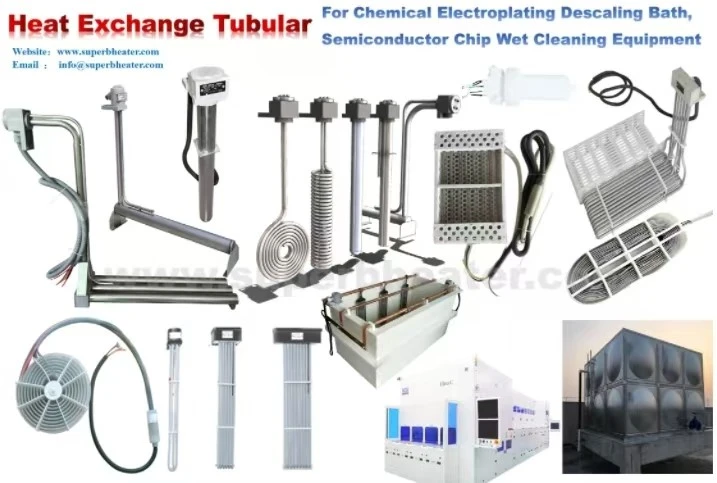
Titanium heating tubes are often supported by brass studs, spacers and clamp bars in corrosive process tanks, because brass is low cost, easily formed and reasonably compatible with many neutral liquors. Designers usually check only the galvanic compatibility between titanium and brass and assume that if the couple is weak or properly isolated, the support will remain stable for years. What is much harder to anticipate is selective leaching of zinc from the brass, which changes the stiffness and mass distribution of the support structure over time. Cartridge brass is nominally 70/30 copper-zinc, but in chloride, ammonia and weakly acidic service, zinc is leached preferentially from the grain boundaries and the more active alpha phase. The brass gradually becomes a porous, copper-rich remnant with lower stiffness, lower fatigue strength and altered dynamic response. If the support softens, the natural frequency of the heater assembly shifts and can enter resonance with pump pulsations, bubbler flow, agitator motion or turbulent vortex shedding. Once resonance begins, cyclic bending stress rises sharply at the tube-to-support contact point, leading to fatigue cracking and eventual failure. The titanium tube itself may be chemically undamaged; the real cause is structural degradation of the brass support.
The mechanism is zinc leaching followed by dynamic detuning and resonance. Selective leaching leaves behind a porous copper structure that retains its shape but loses load-bearing capacity. Stiffness decreases, damping changes and the natural frequency drops. If the new frequency coincides with a major dynamic excitation in the tank, the system enters resonance. Even relatively low-amplitude flow forces can then produce large cyclic deflections at the support location. Titanium is not immune to fatigue when stress amplitude is high enough, especially at stress concentrations such as dents, welds, scratches and contact edges. Resonance also causes impact and fretting at the support interface, further increasing local stress. Because the damage accumulates over months or years, it is not noticed during routine inspections.
Early signs are very indirect: unusual noise, slightly higher vibration readings, or minor rattling at the support. These are often dismissed as normal tank operation.
表格
| Stage | Support Condition | Consequence | Risk Level | Recommended Action |
|---|---|---|---|---|
| Initial zinc leaching | Brass surface turns reddish, slight softening | Stiffness begins to decrease, no resonance yet | Low | Replace brass with titanium or 316L support studs |
| Natural frequency shift | Support becomes visibly porous | Assembly frequency moves toward excitation range | Medium | Measure vibration; modify support stiffness |
| Resonance lock-in | Large cyclic deflection at heater tube | Bending stress rises sharply at contact point | High | Install vibration dampers; detune assembly |
| Fatigue cracking and leakage | Through-wall crack at support location | Structural failure of titanium tube | Critical | Replace heater; redesign support system |
Mitigation is material and dynamic. Replace cartridge brass with titanium, 316L stainless steel or high-nickel alloy supports that do not undergo selective leaching. If brass must be used, specify inhibited brass or apply a dense barrier coating. Measure the natural frequency of the heater assembly early in life and compare it with known excitation frequencies. Add stiffeners, dampers or different support spans to detune the system.
A common misconception is that structural supports can be treated as static components. In summary, zinc leaching softens brass supports, shifts resonance, and induces hidden fatigue in adjacent titanium tubes, so dynamic assessment is as important as corrosion assessment.