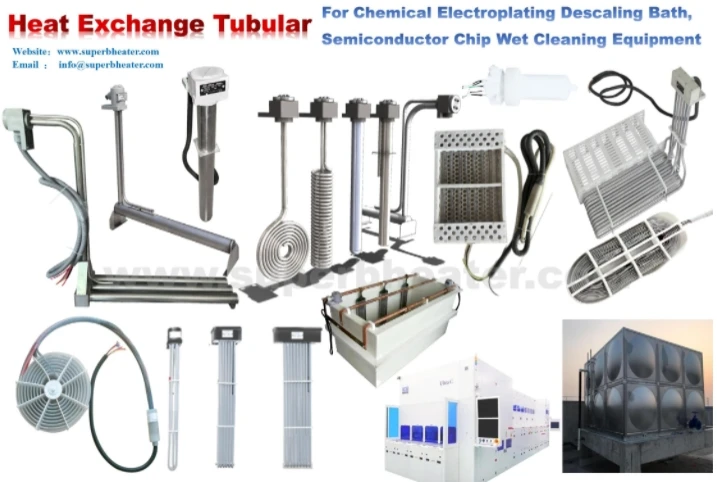
In industrial heating, buyers frequently search for a universal solution. The expectation is understandable: one heater design that can handle any tank, any liquid, and any operating condition. In practice, that assumption often leads to premature failures, safety concerns, and unexpected replacement costs. There is no true "one-size-fits-all" heater. Every industrial process has its own chemical, thermal, and mechanical demands.
For many corrosive applications, Teflon (PTFE) immersion heaters offer exceptional advantages. However, they are not suitable for every scenario. Matching the heater to the application is the foundation of reliable and efficient operation.
Where PTFE Heaters Excel
PTFE heaters dominate in environments where corrosion is the primary concern. Their outer sheath is made from polytetrafluoroethylene, a material known for its near-total chemical inertness within its temperature limits. In processes involving highly aggressive acids, PTFE provides protection that stainless steel and other alloys cannot match.
Electroplating and Surface Treatment
Electroplating lines are among the most demanding chemical environments in industry. Baths may contain chromic acid, hydrochloric acid, sulfuric acid, or complex mixed chemistries. These solutions are often heated to accelerate reaction rates and improve plating quality.
Metal-sheathed heaters in such tanks frequently suffer from pitting or crevice corrosion. In contrast, PTFE-sheathed heaters are widely adopted because they resist chemical attack from chromic acid and even hydrofluoric acid, which is particularly aggressive toward many metals and glass materials. This resistance makes PTFE the standard choice in many plating and pickling operations.
Chemical Processing
In chemical manufacturing, reaction tanks and storage vessels may contain concentrated acids, alkalis, or solvent mixtures. When heating is required, material compatibility becomes critical. PTFE's chemical stability allows it to perform reliably in tanks where metallic materials would degrade rapidly.
Its non-reactive surface also reduces the risk of contamination, which is particularly important in processes requiring high purity or consistent product quality.
PCB Manufacturing
Printed circuit board production involves multiple chemical baths, including etching and cleaning stages. These solutions are often corrosive and operate at elevated temperatures. PTFE immersion heaters are common in PCB lines because they provide chemical resistance while maintaining stable thermal performance across repetitive cycles.
Over-the-Side Heaters vs. In-Line Exchangers
Selecting the correct heater configuration is as important as selecting the right material.
Over-the-side immersion heaters are installed directly into the tank from above. They are easy to install and maintain, making them suitable for many plating and chemical tanks. Their design allows direct heat transfer into the liquid and simplifies replacement without draining the tank.
In-line heat exchangers, on the other hand, are installed within a circulation loop. Liquid is pumped through the exchanger, heated, and returned to the tank. This design provides more controlled heating and improved uniformity, especially in larger systems. It also reduces the risk of localized overheating because forced circulation improves heat transfer efficiency.
In applications where agitation is minimal or temperature consistency is critical, an in-line PTFE heat exchanger may offer better performance than a static immersion heater.
The Advantage of a Non-Stick Surface
One practical benefit often overlooked is PTFE's non-stick property. In processes involving sticky residues, polymers, or crystallizing solutions, buildup on heating surfaces can act as insulation and reduce efficiency. PTFE's low surface energy discourages adhesion, helping minimize scaling and simplifying cleaning.
This characteristic is valuable in both plating baths and certain chemical reactions where deposits form during operation. Reduced buildup not only improves heat transfer but also extends service life.
Understanding the Limitations
Despite its chemical advantages, PTFE is not a universal solution.
First, it has lower mechanical strength compared to stainless steel or other metals. PTFE heaters are not suitable for applications involving heavy mechanical stress, abrasive solids, or physical impact. In tanks where baskets, parts, or tools may strike the heater, metal-sheathed designs may offer better durability.
Second, PTFE has lower thermal conductivity than metal. While this is manageable in properly designed systems with appropriate watt density, it means PTFE heaters must be engineered carefully to prevent excessive surface temperatures.
Third, PTFE has a maximum working temperature, typically around 110°C for continuous service in many industrial heater designs. Applications requiring higher operating temperatures may require alternative materials or heating methods.
When PTFE Is Not the Right Choice
PTFE heaters are generally not recommended for:
High-pressure systems
Applications exceeding their temperature limit
Tanks with aggressive mechanical agitation that may cause impact
Situations where structural strength is a primary requirement
In such cases, alternative materials such as titanium, stainless steel alloys, or external heat exchangers may be more appropriate.
The Importance of Process Matching
Selecting the correct heater requires evaluating both chemical compatibility and physical tank configuration. Key considerations include:
Chemical composition and concentration
Operating temperature
Tank size and geometry
Circulation method
Risk of physical contact or abrasion
A heater that performs flawlessly in an electroplating tank may not be suitable for a high-temperature alkaline cleaning system with heavy mechanical agitation.
Customization as the Industry Standard
In modern industrial production lines, standardized off-the-shelf solutions are rarely optimal. Custom-designed PTFE heaters-whether over-the-side or in-line-are often necessary to ensure proper watt density, correct immersion length, and safe electrical configuration.
Matching the heater type precisely to the chemical process and physical tank layout ensures not only long service life but also operational safety and energy efficiency. In corrosive industries such as electroplating, chemical processing, and PCB manufacturing, this careful alignment between application and equipment is not optional. It is essential for stable production and controlled operating costs.