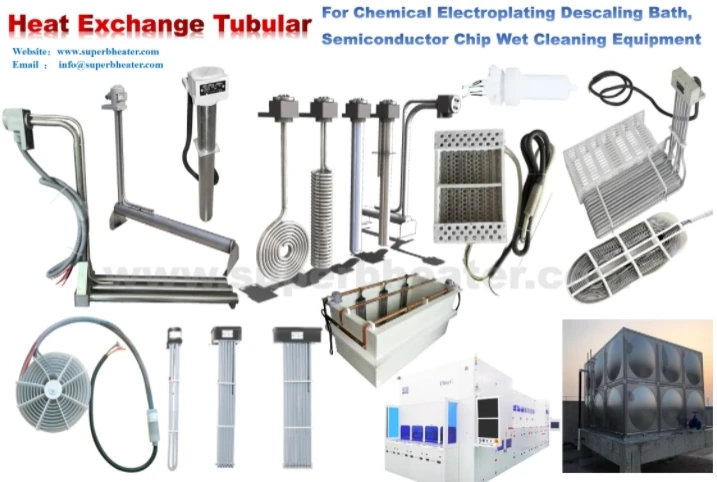
A plating line or chemical batch process that once reached operating temperature in 30 minutes now requires nearly an hour. Production schedules slip, energy meters climb, and operators suspect the PTFE immersion heater has lost performance. The delay feels gradual at first, yet the impact on throughput and operating cost becomes unmistakable. A systematic diagnostic procedure quickly isolates the root cause among several common factors and restores original heating time without unnecessary replacement.
Fouling ranks as the most frequent cause of extended heating time. Even thin layers of scale, polymer film, or precipitated salts on the PTFE sheath act as thermal insulation. Heat generated by the resistance wire transfers poorly into the surrounding liquid, forcing the element to run longer to achieve the same bulk temperature rise. Fouling detection begins with visual inspection of the sheath for discoloration, roughness, or buildup after the heater cools and is removed from the tank. Compare current heat-up curves against baseline data recorded when the unit was new or freshly cleaned. A common early sign of fouling is that the heater runs longer cycles while maintaining the same current draw. Pressure drop across the tank or reduced fluid velocity around the bundle often accompanies surface deposits and confirms the diagnosis. Chemical cleaning or mechanical brushing restores heat transfer efficiency in most cases.
Voltage measurement provides the next critical check. Power output of any resistance heater follows the square of applied voltage (P = V²/R). A 10 percent voltage drop at the terminals therefore produces nearly 20 percent power loss, directly extending heating time by roughly 25 percent. Measure supply voltage at the heater terminals under load with a true-RMS multimeter and compare against the nameplate rating. Voltage issues commonly arise from overloaded circuits, long cable runs, or utility fluctuations. Correction involves dedicated feeders, voltage regulators, or transformer taps rather than heater replacement.
Element degradation develops gradually over thousands of operating hours. Resistance wire can develop hot spots, partial opens, or increased internal resistance from oxidation or metallurgical changes inside the sealed PTFE sheath. The result appears as reduced wattage despite correct voltage. Diagnostic procedure includes current monitoring at full voltage: amperage significantly below nameplate value at stable temperature indicates degradation. Infrared thermography performed during operation reveals cooler zones along the sheath where individual wire sections have weakened. When confirmed, element replacement becomes the only reliable solution because internal repairs are not feasible in sealed PTFE designs.
Liquid level problems reduce effective heating area and mimic other faults. When the liquid level drops below the top of the heated zone, part of the element operates in air or vapor, wasting power and slowing overall heat-up. Operators must verify submersion depth daily against the manufacturer's marked safe minimum. Low-level interlocks prevent dry-firing damage, yet marginal levels still extend heating time without triggering alarms. Corrective action involves recalibrating level controls or adjusting fill procedures.
Additional checks complete the diagnostic procedure. Record and trend inlet fluid temperature, specific heat capacity of the batch, and agitation speed; any deviation from original design values alters required heating time. Compare total energy consumption per batch against historical data-higher kWh per degree of temperature rise points to insulation loss or reduced efficiency.
Identifying the specific cause guides the correct corrective action, whether chemical cleaning for fouling, voltage correction, element replacement, or liquid level adjustment. Each remedy returns the system to original performance with minimal disruption.
Slow heating often accompanies increased energy consumption, which raises another common concern.