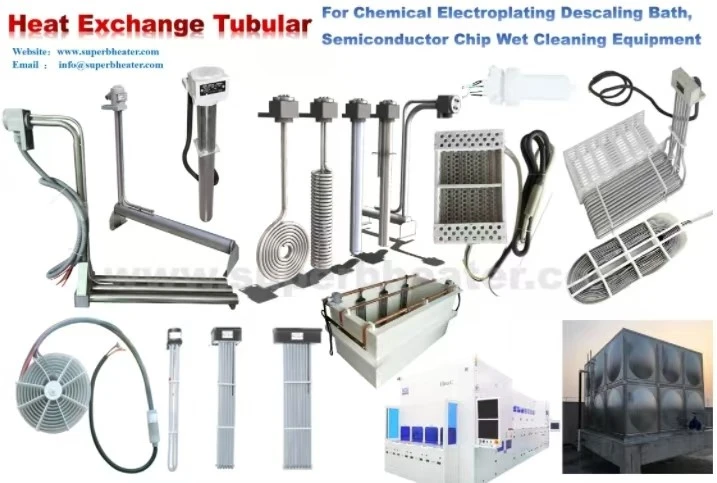
Submerged titanium heating probes have become the mainstream heating component for chemical wet processes owing to outstanding resistance to chloride ions, weak acids and various corrosive organic liquids. The dense passive oxide film naturally formed on titanium surfaces acts as the core barrier against pitting corrosion, yet this protective layer is vulnerable to irreversible damage caused by irregular daily operating behaviors. Mass field monitoring data indicates that most premature pitting failures of titanium probes do not originate from material defects or medium corrosiveness beyond design limits, but stem from long-term improper operational habits. Standardized daily operation norms can effectively maintain passive film integrity and greatly extend the service cycle of submerged titanium heating equipment.
Abnormal temperature rise operations represent one of the most common triggers for titanium passive film failure. Many production teams adopt rapid high-power startup to shorten medium heating time, which creates a sharp temperature gradient between the inner core and outer surface of titanium probes. Instant thermal stress leads to tiny cracks on the compact oxide protective layer, exposing fresh metal matrix to corrosive liquids. Once bare titanium contacts chloride-rich or acidic media, local anodic reactions occur rapidly and gradually evolve into irreversible pitting corrosion. Steady gradient heating operation keeps surface temperature change within a safe range, allowing the passive film to bear thermal expansion evenly without structural cracking.
Unregulated liquid level fluctuation and long-term partial immersion are another typical bad operational habit accelerating probe corrosion. When the liquid level repeatedly rises and falls across the same section of the titanium tube, the alternating conversion between liquid immersion and atmospheric exposure forms a dynamic electrolyte environment on the metal surface. Salt and acid substances continuously precipitate and accumulate at the liquid-gas interface, resulting in high-concentration local corrosive areas. These concentrated pollutants gradually erode the passive layer and induce crevice pitting at the liquid level line. Maintaining a stable liquid level higher than the maximum heating section of probes avoids such alternating corrosion conditions and protects the entire working surface of titanium heating elements.
Irregular offline storage and incomplete surface cleaning before restart also leave hidden risks of pitting damage. Residual corrosive medium attached to the tube surface will crystallize after liquid evaporation during idle periods, forming highly concentrated corrosive salt deposits. If these crystalline pollutants are not thoroughly removed before equipment restart, they will continuously erode the passive film under high-temperature heating conditions. Strict cleaning and sealed preservation standards eliminate residual pollutant accumulation and prevent localized corrosion initiation during standby intervals.
The following table summarizes targeted operational habits for different submerged heating working scenarios:
表格
| Submerged Heating Application Scenario | Standard Operational Habit | Core Anti-Corrosion Function |
|---|---|---|
| High-salinity brine continuous heating | Gradual low-power startup + fixed liquid level control | Prevents thermal shock passive film cracking and liquid level line concentration corrosion |
| Batch acidic chemical reaction heating | Complete surface rinsing before idle storage | Removes residual acid sediments to avoid crystallized local corrosion points |
| Alternating liquid medium heating processes | Full immersion fixed liquid level operation | Eliminates gas-liquid alternating corrosion on partial tube sections |
| Normal atmospheric clean liquid heating | Standard factory startup procedure + periodic surface inspection | Maintains stable passive film state under conventional operating conditions |
Developing standardized operational habits builds a daily protection mechanism for titanium passive films. Even high-grade titanium materials cannot resist long-term cumulative damage from irregular operations. Stable heating modes, fixed immersion depth and standardized idle maintenance collectively restrain the initiation and expansion of pitting defects, helping enterprises reduce equipment replacement costs and unplanned production shutdown losses caused by premature heating probe corrosion failure.