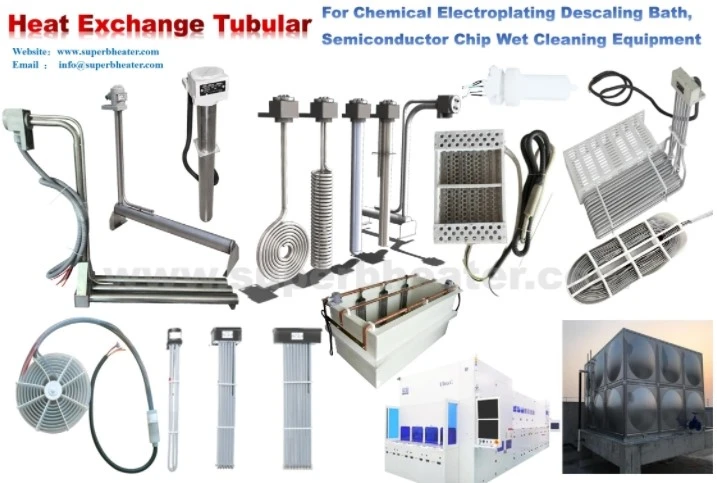
In continuous chemical production, a heating plate may operate for many hours without interruption. The process temperature has to remain stable while fresh solution enters the tank, heat is lost to the environment, and production equipment continuously removes thermal energy.
Under these conditions, selecting a heating plate only by total kilowatts can lead to poor temperature distribution. The required heating plate area is equally important because it determines how widely the thermal load is distributed across the chemical bath.
The practical engineering balance is between heat-transfer capacity and surface heat flux.
Heating Area Starts With the Required Heat Load
The thermal demand of a continuously heated tank can be represented by:
Qtotal = Qprocess + Qloss
For a continuous liquid stream, the process heating load can be approximated by:
Qprocess = ṁCpΔT
where ṁ is mass flow rate, Cp is specific heat capacity, and ΔT is the required temperature increase.
The second component is heat loss through tank walls, the liquid surface, piping, fittings, and surrounding air.
A heating plate must provide enough total power to cover both loads during normal continuous operation.
Why Power Alone Does Not Define Heating Area
Once heating power is known, the required active area can be considered through:
q″ = Q/A
where q″ is surface heat flux and A is effective heating area.
A larger area allows the same power to be distributed across a wider surface.
For example, a 20 kW heating system concentrated over a small area produces a higher heat flux than the same 20 kW distributed over a much larger heating surface.
Higher heat flux can provide rapid local heat transfer, but it also increases the possibility of localized overheating when circulation is limited.
For continuous chemical heating, the objective is usually stable long-term operation rather than maximum local heating intensity.
Continuous Flow Changes the Thermal Requirement
In a continuous process tank, incoming liquid can continuously reduce the bath temperature.
The required heating plate area therefore depends on the flow rate as well as the tank volume.
A large static tank with very low liquid turnover may require relatively little continuous heating after reaching the target temperature. A smaller tank with high chemical flow can require substantially more heating capacity.
This is why tank volume alone is not a reliable basis for heating plate area selection.
Circulation Determines How Much Area Is Effective
Heating area only contributes effectively when the surrounding liquid can remove heat from the surface.
The heat-transfer relationship can be simplified as:
Q = hAΔT
where h represents the effective heat-transfer coefficient.
Strong circulation can improve heat removal around the plate. Weak circulation can create a warm boundary layer that limits practical heat transfer.
If the tank contains high-viscosity chemical solution, internal structures, or narrow flow passages, simply increasing heating power may increase local temperature without improving overall bath uniformity.
In such cases, increasing heating area or redistributing the heating zones may provide a better result.
Different Tank Sizes Need Different Area Strategies
The required heating plate area should be matched to the physical tank and its flow pattern.
| Continuous heating condition | Main thermal issue | Heating-area strategy | Design priority |
|---|---|---|---|
| Small tank, strong circulation | High local heat removal | Moderate area | Compact installation |
| Large tank, strong circulation | Broad thermal load | Large distributed area | Uniform coverage |
| High-flow chemical feed | High continuous heat demand | Larger active area | Heating capacity |
| High-viscosity solution | Weak convection | Increased area, lower heat flux | Temperature stability |
| Long narrow tank | Uneven flow distance | Distributed longitudinal heating | Coverage |
The table illustrates why heating area should be determined from the complete process rather than from a standard plate size.
PTFE Heating Plates Need Area Optimization
For corrosive chemical applications, a PTFE heating plate may be selected because of its chemical resistance.
PTFE has relatively low thermal conductivity compared with common metals. As a result, the relationship between heating-element distribution, plate area, and surface heat flux becomes particularly important.
Increasing the active area can help distribute thermal loading, but the plate should still provide sufficient heating capacity within the available installation space.
Element spacing, plate thickness, operating temperature, and circulation should be considered as part of the same thermal design.
Too Much Area Can Also Be Inefficient
Increasing heating area indefinitely is not necessarily beneficial.
A very large heating surface can increase equipment size, installation complexity, and initial cost. If total heating power remains low, the resulting heat flux may also be too low to achieve the required temperature recovery.
The target should therefore be an appropriate area-to-power ratio, rather than maximum surface area.
Continuous processes also benefit from stable control. Moderate heat flux distributed across an appropriately sized surface can make temperature regulation easier than a highly concentrated heating configuration.
A Practical Sizing Sequence
For continuous chemical heating, the design process can follow this sequence:
Determine flow rate → calculate process heat load → estimate heat loss → establish total heating power → select practical heat flux → calculate active heating area → verify circulation and temperature uniformity.
This sequence prevents heating plate area from being selected independently of the process conditions.
Heating Area Should Reflect Real Production Conditions
The required heating plate area is determined by more than tank dimensions. Chemical flow rate, temperature rise, specific heat, heat loss, circulation, liquid viscosity, material selection, and allowable heat flux all influence the final design.
A continuous chemical process generally benefits from sufficient heating area to distribute thermal energy without creating excessive local surface temperature.
For custom or replacement heating plates, actual production flow, operating temperature, chemical concentration, tank geometry, circulation conditions, and available installation space provide the essential design basis. Matching the active heating area to these conditions can improve temperature uniformity, reduce thermal stress, and support stable long-term operation.