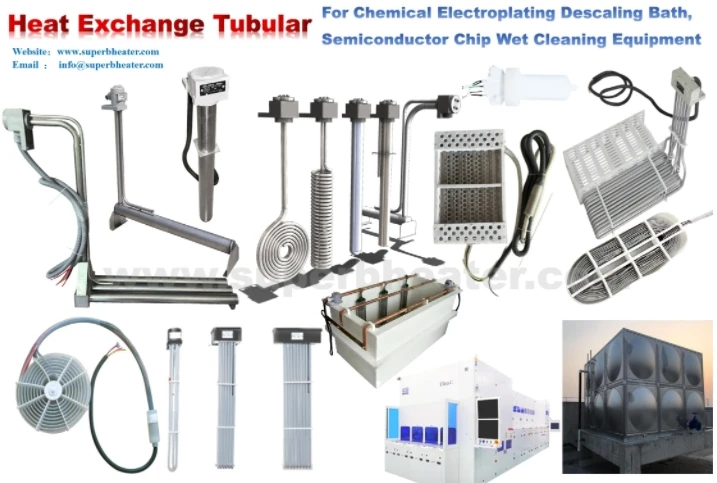
The Installation Dilemma
A new chemical tank requires heating, and the process fluid demands a PTFE immersion heater for corrosion resistance. The tank walls, however, are already crowded with level sensors, recirculation lines, and sampling ports. The top opening is accessible, but overhead cranes and maintenance walkways occupy the space above. The engineer must decide: should the heater be installed using a top-mounting configuration that hangs into the tank, or should it penetrate the side wall through a dedicated tank nozzle?
This decision affects far more than initial installation. Mounting orientation influences maintenance access, mechanical stability, sealing integrity, and even heating performance. Understanding the trade-offs between top-mounting and side-mounting allows the heating system to integrate smoothly into the overall tank design.
Characteristics of Top-Mounting
Top-mounting configurations suspend the heater vertically from the tank rim, cover, or a structural support bridge. The heated section hangs freely into the fluid, while the terminal housing remains above the tank opening.
One of the primary advantages of top-mounting is maintenance access. The heater can typically be lifted straight out of the tank without draining the vessel. In practice, top-mounting is often preferred for smaller tanks where the heater can be easily lifted out by one person during maintenance. This reduces downtime and simplifies routine inspection.
Top-mounted heaters also avoid side-wall penetrations. Tanks made from plastic or lined steel may benefit from minimizing wall nozzles to reduce potential leak points. Installation is usually straightforward, particularly in open-top tanks common in plating or surface treatment operations.
However, top-mounting introduces its own constraints. Overhead clearance becomes a critical parameter. Sufficient vertical space is required to extract the full heater length during servicing. If overhead cranes, ductwork, or platforms interfere, removal may be difficult or impossible without disassembling surrounding equipment.
Longer unsupported heater lengths are another consideration. In deep tanks, a vertically suspended heater may experience vibration or deflection due to fluid movement or agitation. Proper support brackets or guide frames may be necessary to maintain mechanical stability and avoid contact with tank walls or workpieces.
Characteristics of Side-Mounting
Side-mounting configurations insert the heater horizontally or at a slight angle through a tank nozzle. The heater flange bolts directly to the tank wall, forming a sealed penetration.
This approach produces a cleaner tank interior profile. The heater remains anchored at the wall, often positioned below the working level of overhead handling systems. There is no need for vertical removal clearance equal to the full heater length. This can be a decisive advantage in facilities with limited overhead clearance.
A common consideration is the tank cover; if the tank is fully enclosed, side-mounting through a flanged nozzle is usually the only practical option. Enclosed tanks, particularly those handling fumes or hazardous vapors, often require sealed access points. A side-mounted heater integrates neatly with this design.
Mechanical stability is generally improved in side-mounting because the flange connection provides rigid support. However, the tank penetration must be properly sealed. The tank nozzle, flange gasket, and mounting hardware become critical leak-prevention components. Improper sealing can lead to chemical leakage and structural degradation.
Maintenance access can be more complex. Removing a side-mounted heater may require draining the tank below the nozzle level. In larger vessels, this increases downtime and operational disruption. Additionally, horizontal extraction space must be available outside the tank wall to withdraw the heater during servicing.
Heating Performance Considerations
Mounting orientation can influence heat distribution. Top-mounted heaters tend to promote vertical convection currents as heated fluid rises and circulates downward along tank walls. This can support uniform temperature distribution in open tanks.
Side-mounted heaters introduce heat laterally. In well-agitated systems, orientation may have minimal impact. In quiescent fluids, however, heater placement should encourage effective circulation. Positioning the heater near recirculation inlets or agitation zones improves temperature uniformity.
Avoiding interference with internal equipment is essential. Agitators, baskets, racks, or coils may restrict heater placement. In plating tanks, for example, side-mounting can prevent obstruction of workpiece movement from overhead hoists. Conversely, in tanks with dense side-wall instrumentation, top-mounting may offer clearer installation space.
Tank Size and Structural Implications
Tank dimensions strongly influence mounting choice. In shallow tanks, top-mounting is often straightforward. In very deep tanks, extraction length may exceed available overhead space, favoring side-mounting.
Structural design must also be considered. Plastic tanks may deform under concentrated flange loads from side-mounted heaters unless properly reinforced. In such cases, backing plates distribute mechanical stress. Top-mounted heaters, by contrast, transfer load to the tank rim or support bridge.
Weight is another factor. Larger, higher-power PTFE heaters may require robust flange connections more typical of side-mounting. Suspended configurations must ensure that tank rims or brackets can safely support the heater mass.
Maintenance Strategy and Operational Priorities
The frequency of maintenance often determines the optimal configuration. If regular removal is anticipated due to scale buildup or inspection protocols, top-mounting simplifies access. If long service intervals are expected and tank integrity is paramount, side-mounting may provide a more integrated solution.
Operational environment matters as well. Facilities with limited floor space but ample vertical clearance may favor top-mounting. Sites with strict vapor containment requirements or fully enclosed tanks may necessitate side-mounting through sealed nozzles.
Hybrid and Custom Solutions
In some cases, neither conventional top-mounting nor standard side-mounting fully satisfies layout constraints. Angled installations, custom brackets, or partially recessed mounting arrangements can provide hybrid solutions. Adjustable support bridges or articulated brackets allow heaters to enter from the top at controlled angles, minimizing interference while preserving maintenance access.
Conclusion
The choice between top-mounting and side-mounting represents a balance between maintenance access and tank layout constraints. Top-mounting offers convenient removal and reduced wall penetrations but demands sufficient overhead clearance and careful support. Side-mounting provides a streamlined tank interior and stable anchoring through a tank nozzle but may require draining for maintenance and precise sealing.
Evaluating overhead clearance, tank size, maintenance frequency, and internal equipment layout ensures the selected configuration aligns with operational priorities. Where standard approaches are limited by space or access requirements, custom mounting strategies can bridge the gap and deliver reliable, efficient tank heating performance.