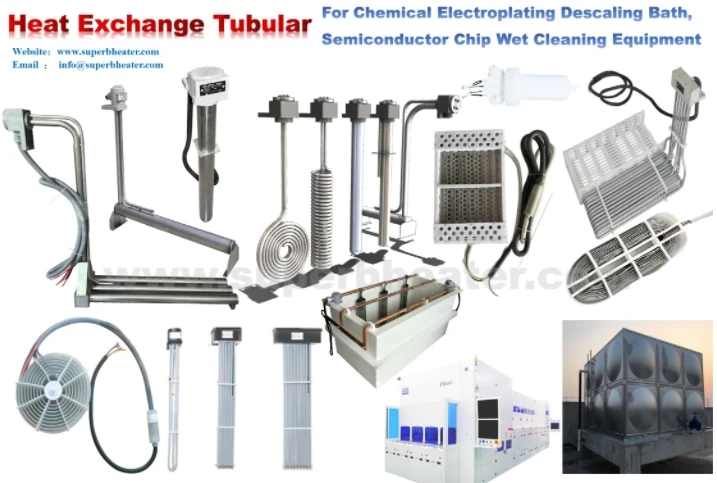
Plant electrical engineers often face a fundamental decision when specifying PTFE immersion heaters: whether to use single-phase or three-phase power. The choice affects not only wiring size and breaker ratings but also system efficiency, load balancing, and future scalability. With both power supplies typically available in industrial facilities, the correct selection depends on total power demand, existing infrastructure, and long-term operational needs.
Understanding the Basic Electrical Differences
Single-phase power is the simpler and more common supply for lower-power applications. It uses one live conductor and a neutral, delivering power in a single sinusoidal wave. For PTFE heaters, single-phase is straightforward to install and control, making it suitable for individual heaters up to approximately 3–5 kW. However, because all current flows through a single phase, the amperage is higher for the same power output. This requires larger cable cross-sections and higher-rated breakers, increasing material and installation costs.
Three-phase power, by contrast, uses three live conductors (phases) offset by 120 degrees. This configuration allows significantly higher total power delivery with smaller conductors because the current is divided across the three phases. For the same power rating, three-phase systems draw roughly 58% of the current per conductor compared to single-phase, resulting in lower I²R losses, reduced voltage drop, and more economical wiring.
When to Choose Single-Phase
Single-phase remains the preferred choice in several common situations:
Individual heaters rated 5 kW or less
Small-scale or pilot installations
Facilities where only single-phase power is readily available near the tank
Applications where simplicity of control and wiring is prioritized over efficiency
In these cases, the engineering overhead is lower, and the system can often be controlled directly with standard single-phase PID controllers or contactors.
When Three-Phase Configuration Is Advantageous
For total heating loads above 10–12 kW, three-phase distribution is almost always more economical and technically superior. Key benefits include:
Smaller cable sizes and lower installation costs
Better load balancing across the electrical system
Reduced neutral current when multiple heaters are used
More efficient power delivery and lower energy losses
Easier integration with modern motor control centers and PLC systems
When multiple PTFE heaters are installed in the same tank or across several tanks, a three-phase supply allows the heaters to be distributed evenly across the three phases. Proper phase balancing prevents overload on any single phase or the neutral conductor, which is a common cause of transformer heating and nuisance tripping.
Practical Selection Guidance
A useful decision framework is based on total connected load:
Under 9 kW total: Single-phase is usually sufficient and simpler.
9–20 kW total: Three-phase becomes more cost-effective, especially if long cable runs are involved.
Above 20 kW: Three-phase is almost always the better choice for efficiency and scalability.
Another important consideration is future expansion. If additional heating capacity is likely in the next few years, designing the system for three-phase from the beginning avoids costly rewiring later.
A common mistake is connecting several large single-phase heaters across a three-phase supply without proper phase balancing. This can lead to heavily loaded phases, neutral overloads, and increased transformer heating. When using single-phase heaters on a three-phase system, they should be deliberately distributed (e.g., Heater A on L1-N, Heater B on L2-N, Heater C on L3-N) to maintain balance.
Conclusion
The choice between single-phase and three-phase power for PTFE heaters involves clear trade-offs in complexity, cost, and scalability. Single-phase offers simplicity for smaller loads, while three-phase provides efficiency, better load distribution, and easier expansion for larger installations.
For very large or complex heating systems, consulting with an electrical engineer to design a balanced distribution system ensures optimal performance, safety, and long-term cost efficiency. Proper selection of the power supply configuration is a foundational decision that affects not only initial installation but also the reliability and energy consumption of the entire heating system.