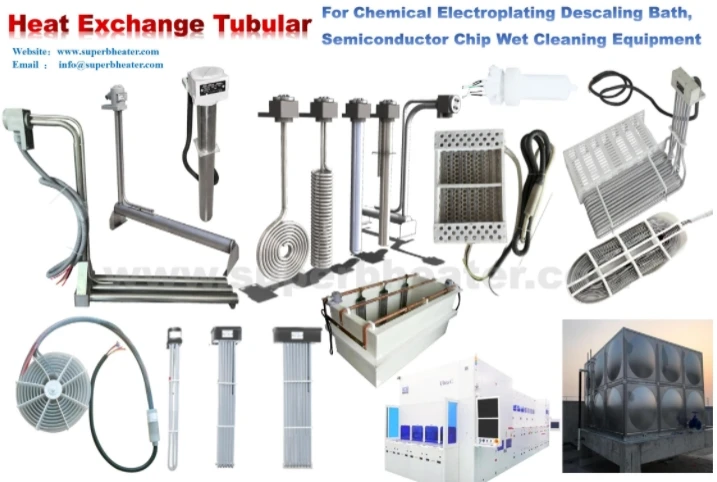
A familiar maintenance scenario illustrates the importance of gasket material selection. A PTFE immersion heater is installed with a new flange gasket. Within weeks, leakage appears around the joint. Inspection shows the gasket has swollen, softened, or degraded after exposure to the process fluid. The heater must be removed, the tank drained, and production interrupted. The root cause is not improper bolt torque or poor workmanship, but incorrect gasket material.
For maintenance and engineering teams, this situation underscores a key reality: not all gasket materials are equal. The reliability of a flange seal depends as much on chemical compatibility and temperature rating as on installation quality. Selecting the correct gasket material is fundamental to long-term performance.
Chemical Compatibility as the Primary Filter
The first criterion in gasket selection is chemical compatibility. PTFE immersion heaters are commonly used in highly corrosive services such as acid pickling, alkaline cleaning, and electroplating baths. The gasket material must resist attack by the same process chemicals.
Expanded PTFE gaskets are widely regarded as the most versatile solution for corrosive environments. Their chemical resistance closely matches that of the heater sheath itself. Expanded PTFE is inert to most acids, alkalis, and solvents, making it suitable for aggressive process fluids. In practice, virgin expanded PTFE gaskets successfully handle the majority of corrosive chemical services with excellent long-term stability.
A common mistake is the use of standard compressed fiber gaskets in acid service. These materials may perform adequately in water or mild hydrocarbon applications but can degrade rapidly in strong acids. Failure may manifest as swelling, embrittlement, or chemical breakdown, sometimes contaminating the bath. Proper material certification and compatibility verification prevent such avoidable failures.
Expanded PTFE and Its Advantages
Expanded PTFE offers several performance advantages beyond chemical resistance. Its compressibility and conformability allow it to adapt to minor flange irregularities, improving sealing performance even when flange faces are not perfectly smooth. This characteristic reduces the need for excessive bolt torque, thereby lowering stress on PTFE heater flanges.
Temperature rating is also favorable. Expanded PTFE typically withstands continuous service temperatures up to approximately 260 degrees Celsius, depending on pressure conditions. For most immersion heater applications, this range is sufficient. However, temperature must be evaluated not only at nominal operating conditions but also at potential peak excursions.
Because PTFE exhibits creep under sustained load, attention must be given to bolt re-torque requirements after initial thermal cycling. Even though expanded PTFE performs well, some relaxation may occur at elevated temperature.
Filled PTFE for Improved Creep Resistance
In applications involving higher pressure or elevated temperature, filled PTFE gasket materials may offer advantages. Fillers such as glass fiber or silica improve creep resistance and dimensional stability. These materials reduce cold flow under sustained compressive stress, which can enhance long-term sealing reliability in demanding conditions.
However, filled PTFE may sacrifice some conformability compared to virgin expanded PTFE. Selection must balance mechanical strength against sealing adaptability. Additionally, filler compatibility with the process fluid should be verified, particularly in highly pure chemical systems where contamination is a concern.
For heater flanges operating at higher bolt loads or elevated temperature extremes, filled PTFE can provide improved structural integrity while maintaining broad chemical compatibility.
Elastomeric O-Rings and Specialty Seals
Certain heater flange designs incorporate O-rings rather than flat gaskets. In these cases, elastomeric materials such as FKM or FFKM may be specified. These materials offer flexibility and excellent sealing under lower bolt loads.
Chemical compatibility is critical when selecting elastomers. While FKM provides strong resistance to many oils and moderate chemicals, it may not tolerate certain concentrated acids or high-temperature alkaline environments. FFKM offers superior chemical resistance and high temperature capability but at significantly higher cost.
Elastomer temperature rating must include both continuous and peak values. Transient temperature spikes during startup or upset conditions can exceed nominal operating temperature and compromise seal integrity. Reviewing the full thermal profile of the process ensures that the chosen O-ring material remains within its safe operating envelope.
Matching Material to Temperature and Pressure
Gasket performance depends on the combined influence of chemical environment, temperature range, and internal pressure. A material compatible at room temperature may degrade at elevated temperature. Similarly, a gasket rated for chemical exposure may lack sufficient creep resistance under sustained flange pressure.
A comprehensive specification review should confirm maximum operating temperature, peak temperature excursions, system pressure, and any cyclic conditions. Pressure rating influences the required compressive load and, therefore, the need for creep-resistant materials.
Material certification from reputable suppliers provides assurance that the gasket material meets stated chemical and temperature ratings. Documentation supports traceability and compliance in regulated industries.
Establishing a Reliable Seal Foundation
Material selection is the foundation of a reliable flange seal. Expanded PTFE remains the preferred choice for most corrosive chemical services due to its chemical compatibility, conformability, and broad temperature rating. Filled PTFE variants offer improved creep resistance where mechanical loading is higher. Elastomeric O-rings such as FKM or FFKM serve specialized applications requiring flexibility, provided compatibility is verified.
Careful evaluation of chemical exposure, operating temperature, pressure conditions, and material certification ensures that gasket material aligns with service demands. When the correct material is selected, long-term sealing performance becomes predictable and stable.
With the appropriate gasket material in place, the next critical step is correct installation. Proper bolt torque, tightening sequence, and flange alignment complete the sealing system and translate material selection into dependable field performance.