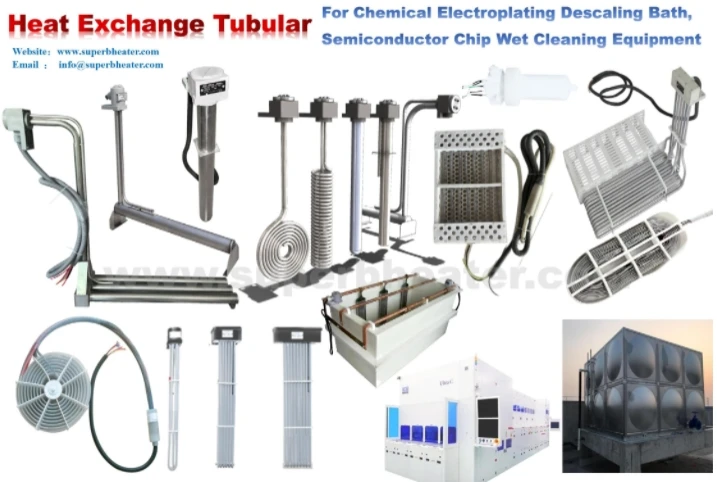
A production line is restarted after a scheduled upgrade. A new fluoroplastic immersion heater has just been installed in a corrosive tank. Within days, operators notice a fine crack near the mounting point. Shortly after, chemical solution begins to seep through. The tank must be shut down, drained, and neutralized. The facility faces downtime, cleanup costs, and potential safety exposure.
The heater itself was high quality. The failure did not come from chemical attack. It came from improper fixation.
In corrosive environments, PTFE (polytetrafluoroethylene) heaters are indispensable because of their exceptional chemical resistance. However, unlike metal heaters, they require specific mounting strategies. Understanding how to secure them without inducing stress is essential for long-term, leak-free operation.
Why PTFE Mounting Is Different from Metal
Metal immersion heaters are mechanically rigid and tolerate clamping pressure well. Stainless steel or titanium tubes can be firmly secured using metal brackets or compression fittings without immediate structural damage.
PTFE behaves differently. It has a much higher coefficient of thermal expansion than metals. When heated, it expands significantly more than stainless steel or carbon steel. During cooling, it contracts again. This continuous expansion and contraction cycle-known as thermal cycling-places stress on any rigid constraint.
If a PTFE tube is clamped tightly with metal hardware, the material has no room to move. Over time, the repeated stress concentration at the clamp point leads to micro-cracking. Eventually, a visible crack forms, typically near the flange or mounting interface. In corrosive service, even a small crack can quickly develop into a leak.
The issue is not material weakness. It is improper mechanical restraint.
Chemical Compatibility of Mounting Hardware
Mounting hardware must match the chemical resistance of the heater sheath. Using carbon steel brackets in an acid tank will result in corrosion. Even stainless steel hardware may degrade in strong acids, contaminating the bath or weakening structural support.
For this reason, industry best practice is to use PTFE or PPS (polyphenylene sulfide) mounting brackets and flanges when working in aggressive chemical environments. These materials provide strong chemical resistance while maintaining sufficient mechanical strength for tank applications.
Flanges and brackets should be selected based on both chemical exposure and operating temperature. Compatibility charts and supplier recommendations should always guide material selection.
Avoid Rigid Metal Clamps on PTFE Tubes
One of the most common installation errors is tightening rigid metal clamps directly onto the PTFE heating tube. Installers often assume that firm clamping ensures stability. In reality, this practice creates stress points.
When the heater warms up, the PTFE expands. If it is trapped under a rigid clamp, internal stress builds at the contact interface. Over multiple heating cycles, stress cracks form. These cracks frequently originate at the mounting point because it is the location of maximum mechanical constraint.
According to industry experience, clamps should never directly compress the PTFE sheath. If additional support is required, it must be designed to allow movement.
The Role of Floating Flanges
Floating flanges are widely used to accommodate thermal expansion. Unlike fixed flanges, floating designs allow slight axial movement of the heater tube during thermal cycling.
In practice, the flange secures the heater at the tank wall while permitting controlled expansion along the length of the tube. This reduces mechanical stress and preserves structural integrity.
Gaskets used at the flange interface must also be chemically compatible and compressed evenly. Over-tightening flange bolts can distort the PTFE material, especially in plastic tank walls. Bolts should be tightened in a cross pattern with controlled torque.
Adjustable Mounting Frames for Larger Tanks
In larger open-top tanks, immersion heaters may extend significantly into the bath. To prevent vibration or accidental contact with the tank wall, support frames are often required.
Instead of rigid frames, adjustable mounting systems are recommended. These frames provide guidance and positional stability without restricting linear expansion. The heater can move slightly as temperature changes, avoiding stress concentration.
Support points should use chemically resistant saddles or guides rather than tight clamps. Clearance between the heater and tank walls must be maintained to prevent contact during expansion.
Considerations for Different Tank Types
Mounting strategies differ depending on tank configuration.
Open-top tanks commonly use over-the-side heaters secured with brackets resting on the tank edge. In this case, expansion is typically directed horizontally, and sufficient space must be allowed for movement.
In contrast, closed or pressurized vessels require flange-mounted immersion heaters. In these systems, sealing integrity becomes critical. Proper gasket selection, torque control, and allowance for thermal movement are essential to prevent leaks.
Pressurized systems demand even greater precision because mechanical stress combines with internal pressure forces. Professional engineering evaluation is strongly recommended in these cases.
Installation Best Practices
To avoid cracking and leakage, the following principles should guide installation:
Use chemically compatible PTFE or PPS mounting hardware.
Avoid direct rigid clamping on the PTFE sheath.
Allow space for thermal expansion and contraction.
Use floating flanges where appropriate.
Tighten flange bolts evenly and to recommended torque values.
Maintain proper clearance from tank walls and internal structures.
These steps may appear simple, but overlooking any one of them can lead to premature failure.
Protecting Integrity Through Proper Fixation
PTFE heaters provide outstanding chemical resistance in aggressive industrial processes. However, their mechanical behavior differs significantly from metal components. Proper fixation is not a minor detail-it is central to system reliability.
A cracked mounting point not only interrupts production but also creates safety risks in corrosive environments. Preventing such failures requires understanding thermal expansion, selecting compatible mounting materials, and designing for movement rather than restraint.
Different tank configurations-whether open-top chemical baths or pressurized vessels-require tailored mounting strategies. Professional assessment of the tank layout and operating conditions ensures that the heater remains secure, flexible, and leak-free over the long term.
In corrosive heating applications, careful mounting preserves both equipment integrity and operational safety.