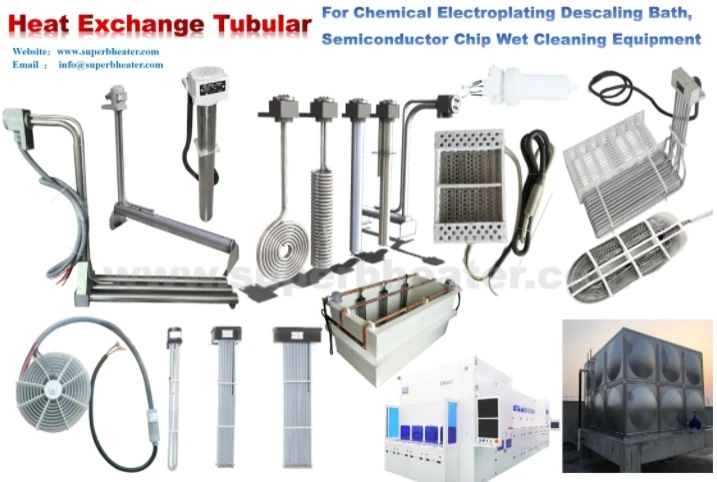
A 2000-liter plating tank needs to be heated and held at 60°C. A single small heater won't cut it. How can PTFE heating plates be scaled up to handle such large volumes? Is it simply a matter of using bigger plates, or are there additional considerations?
Scaling thermal systems for industrial vessels like plating baths, chemical reactors, or storage tanks over 1000 liters introduces complexities far beyond benchtop heating. Heating a large tank is a systems engineering problem, not just a heater selection problem. Power requirements escalate with volume for initial heat-up-where energy must raise the entire mass to setpoint-and with surface area for steady-state maintenance, countering losses to ambient air, evaporation, or conduction. For a 2000L tank, achieving a 40°C rise in under an hour might demand 20-50 kW, depending on insulation and contents. Uniformity becomes the core challenge: uneven heat input creates thermal gradients, leading to inconsistent plating thickness, stratified reactions, or even safety hazards like localized boiling in volatile chemicals. PTFE heating plates, with their corrosion resistance and external mounting, offer a robust solution, but successful implementation demands careful sizing, zoning, and integration to distribute this power effectively.
The foundational principle in scaling is balancing heat supply against demand. Heat-up power scales roughly with volume and specific heat capacity of the contents-water-based solutions require about 4.2 kJ/kg·°C-plus a safety factor for inefficiencies. Once at temperature, the system shifts to compensating losses, which are dominated by surface area: convection and radiation from walls and lids can siphon 100-500 W/m² in uninsulated tanks. Experience shows that zoning is the key to uniformity in large volumes. Rather than relying on a monolithic heater, array multiple PTFE plates beneath the tank bottom. Standard plates, often 1x1 or 1x2 meters, can be tiled to cover expansive footprints, delivering distributed heat through the tank material (e.g., polypropylene or stainless steel lined with fluoropolymers). This modularity avoids the fabrication challenges and high costs of custom mega-plates, while allowing phased power delivery. For a 3000L rectangular plating bath, four 5 kW plates might suffice, wired in parallel but controllable independently to address asymmetries-such as greater losses near exposed edges or agitator zones.
Zoned control elevates this strategy, treating the tank as a multi-region system. Each plate or group can tie to its own PID controller and temperature sensor, enabling fine-tuning. In a long, narrow tank, for instance, end zones might run 2-5°C hotter to offset boundary cooling, ensuring the core remains uniform within ±1-2°C. This compensates for non-ideal fluid dynamics: even with recirculation pumps, large volumes can develop dead spots where cooler fluid pools. PTFE plates facilitate zoning through their etched-foil elements, which provide inherent surface uniformity, minimizing intra-plate gradients. Their external placement also simplifies wiring and maintenance-crucial for large equipment where downtime costs thousands per hour-without exposing internals to corrosive contents like chromic acid or cyanide baths.
Heat loss management is equally vital, as oversized heaters waste energy and strain controls. Large tanks amplify losses: a 2000L vessel with 10 m² surface area might dissipate 5-10 kW at 60°C above ambient without mitigation. Insulate sides and bottoms with polyurethane foam or mineral wool (R-values >3 m²·K/W), reducing this by 70-80%. For open baths, floating polypropylene balls or automated lids curb evaporative cooling, which can exceed 1 kW/m² in humid environments. These measures shrink required heater power, allowing PTFE plates to focus on precision rather than brute force. Practical sizing starts with a heat transfer calculation: estimate heat-up as Q = m·c·ΔT / t, where m is mass, c specific heat, ΔT rise, and t time; add steady-state losses via U·A·ΔT, with U as overall heat transfer coefficient (0.5-2 W/m²·K for insulated tanks). A rule of thumb: 10-15 kW per 1000L for moderate heat-up in well-insulated systems, but adjust for factors like agitation (which enhances internal convection) or viscous fluids (which resist mixing). Consult software like Aspen or simple spreadsheets for accuracy, factoring in PTFE's thermal conductivity (~0.25 W/m·K) and tank wall resistance.
Sensor placement underpins effective control in these scales. A single probe risks misrepresenting the volume-place multiple RTDs or thermocouples at varying depths and positions (e.g., center, edges, inlet/outlet) to monitor gradients and average for master control. In zoned setups, dedicate sensors per zone, feeding data to a PLC for automated balancing. PTFE plates' corrosion resistance shines here, as their inert surfaces withstand spills during sensor installation or tank cleaning, ensuring long-term reliability.
Successful heating of large tanks with PTFE plates requires a holistic approach-right-sizing, zoning, and loss management. By integrating multiple plates with intelligent controls and insulation, engineers achieve uniform, efficient thermal performance that scales reliably. This system-level thinking is essential for any industrial process where scale magnifies thermal challenges, from electroplating to bulk chemical storage, delivering consistent quality and operational savings.