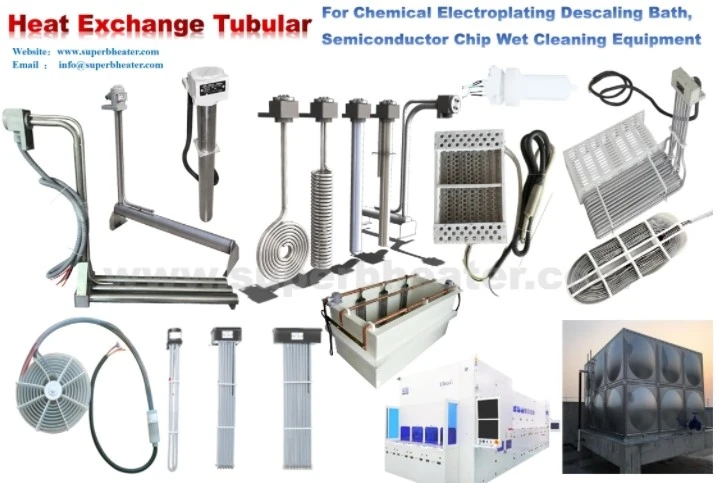
Spare parts inventory for PTFE immersion heaters is a budget line that is rarely examined until it becomes a problem. When the heater failure rate is low, the inventory accumulates slowly and the budget is stable. When the failure rate rises-because the heaters are undersized, the chemistry is aggressive, or the operating conditions are harsher than expected-the inventory is consumed faster, the replenishment orders become more frequent, and the budget becomes a source of friction between maintenance and finance.
The replacement frequency is the variable that connects the heater's service life to the inventory budget. Understanding the relationship-and the factors that shift it-is the first step toward an inventory strategy that avoids both stockouts and excess.
The Inventory Cost Structure
The cost of spare parts inventory has three components: the holding cost, the ordering cost, and the stockout cost.
The holding cost is the cost of storing the spare parts, including the warehouse space, the insurance, the obsolescence, and the capital tied up in the inventory. It is typically 20–30% of the inventory value per year.
The ordering cost is the cost of placing and receiving an order, including the procurement labor, the freight, and the inspection. It is typically $200–$500 per order, depending on the supplier and the part.
The stockout cost is the cost of not having a spare part when it is needed, including the downtime, the expedited freight, and the production loss. It is the largest of the three components in a high-value line, and it is the one that drives the inventory level.
The replacement frequency determines how often the inventory is consumed, and therefore how much inventory is needed to avoid stockouts. A higher replacement frequency requires a larger inventory or a shorter replenishment lead time.
The Replacement Frequency Range
PTFE immersion heaters in plating, PCB, and chemical process applications have replacement frequencies that vary by an order of magnitude, depending on the material, the construction, the chemistry, and the operating conditions.
A premium heater in a mild chemistry with good maintenance may last 6–10 years, which is a replacement frequency of 0.1–0.17 heaters per year.
A standard heater in a moderate chemistry with average maintenance may last 3–5 years, which is a replacement frequency of 0.2–0.33 heaters per year.
A cheaper heater in an aggressive chemistry with poor maintenance may last 1–2 years, which is a replacement frequency of 0.5–1.0 heaters per year.
A heater in a severe application-high temperature, aggressive chemistry, frequent thermal cycling-may last 6–12 months, which is a replacement frequency of 1.0–2.0 heaters per year.
The Inventory Policy Options
There are three inventory policy options for PTFE heaters: on-demand ordering, safety stock, and consignment.
On-demand ordering places an order when a heater fails, and waits for the lead time before the replacement is available. The policy has the lowest holding cost but the highest stockout risk, and it is appropriate only for heaters with a long service life and a short lead time.
Safety stock keeps one or more heaters on hand, and replenishes the stock when a heater is used. The policy has a higher holding cost but a lower stockout risk, and it is appropriate for heaters with a moderate service life and a moderate lead time.
Consignment keeps the heaters at the plant but owned by the supplier until they are used. The policy has the lowest holding cost for the plant but requires a supplier agreement, and it is appropriate for heaters with a high replacement frequency and a long lead time.
A Comparison Table for Inventory Policy and Replacement Frequency
The following table summarizes the inventory policy options for different replacement frequencies.
| Replacement Frequency | Typical Service Life | Recommended Inventory Policy | Safety Stock Level | Annual Holding Cost (per heater value) | Stockout Risk |
|---|---|---|---|---|---|
| 0.1/year | 10 years | On-demand ordering | 0 | Low | Low if lead time < 1 month |
| 0.2/year | 5 years | On-demand ordering with a supplier agreement | 0–1 | Low to moderate | Moderate if lead time > 1 month |
| 0.33/year | 3 years | Safety stock of 1 | 1 | Moderate | Low |
| 0.5/year | 2 years | Safety stock of 1–2 | 1–2 | Moderate to high | Low |
| 1.0/year | 1 year | Safety stock of 2, or consignment | 2 | High | Low with safety stock; high without |
| 2.0/year | 6 months | Consignment or a service contract | 2–3 | High with safety stock; low with consignment | Low with consignment; high without |
The table assumes a heater value of $4,000, a holding cost of 25% per year, and a lead time of 4–8 weeks. The values should be adjusted for the actual heater value, holding cost, and lead time.
The Cost of Stockouts
The stockout cost is the largest component of the inventory cost in a high-value line, and it is the component that drives the inventory level.
A stockout occurs when a heater fails and there is no spare on hand. The line is down until a replacement is procured and delivered, which may take 4–8 weeks for a standard heater and longer for a custom heater.
The downtime cost during the stockout is the production loss multiplied by the downtime duration. In a high-value line, the downtime cost can be $50,000–$100,000 per day, which means a 4-week stockout costs $1,000,000–$2,000,000 in production loss-far more than the inventory holding cost of a spare heater.
A Diagnostic Table for Inventory Budget Problems
The following table summarizes the symptoms that indicate the inventory budget is not matched to the replacement frequency, and the corrective action for each.
| Symptom | Indication | Corrective Action |
|---|---|---|
| Frequent stockouts | Safety stock too low for the replacement frequency | Increase the safety stock or negotiate a shorter lead time |
| High inventory value with low usage | Safety stock too high for the replacement frequency | Reduce the safety stock; use on-demand ordering |
| Obsolete heaters in stock | Process change without an inventory review | Review the inventory against the current process; write off obsolete heaters |
| Degraded heaters in stock | Shelf life exceeded | Implement a first-in-first-out policy; inspect the heaters before use |
| High holding cost | Inventory level too high | Reduce the safety stock; negotiate consignment |
| Frequent expedited orders | Lead time too long for the replacement frequency | Negotiate a shorter lead time; increase the safety stock |
| Downtime from a heater failure | Stockout or long lead time | Increase the safety stock; negotiate a service contract |
Selection Guidance
The inventory policy should be matched to the replacement frequency and the lead time, not to the heater price or the warehouse space.
For heaters with a low replacement frequency and a short lead time, on-demand ordering is the appropriate policy.
For heaters with a moderate replacement frequency and a moderate lead time, a safety stock of one heater is appropriate.
For heaters with a high replacement frequency and a long lead time, a safety stock of two heaters or a consignment agreement is appropriate.
Specification Guidance
A PTFE immersion heater specification that supports the inventory budget should include the following.
The expected service life and the replacement frequency.
The lead time for a replacement heater.
The heater value and the holding cost.
The downtime cost per day and the stockout risk.
The shelf life and the storage conditions.
The supplier agreement for the lead time and the availability.
A heater supplier who has this information can provide the expected service life and the lead time, and can support the inventory policy decision. The selection should be stated explicitly in the specification, with the basis for the replacement frequency and the inventory policy.
When Standard Inventory Cannot Meet the Uptime Requirement
Applications with a high replacement frequency, a long lead time, or a high downtime cost often require an inventory strategy beyond the standard. This may mean a consignment agreement with the supplier, a service contract with a guaranteed response time, or a spare heater kept on site with a scheduled replacement program.
Providing the actual replacement frequency, lead time, and downtime cost at the specification stage allows the inventory strategy to be designed around the uptime requirement rather than around the warehouse space. For installations where stockouts have already caused downtime, a replacement frequency analysis combined with an inventory review is more likely to identify the correct strategy than a simple increase in the safety stock.