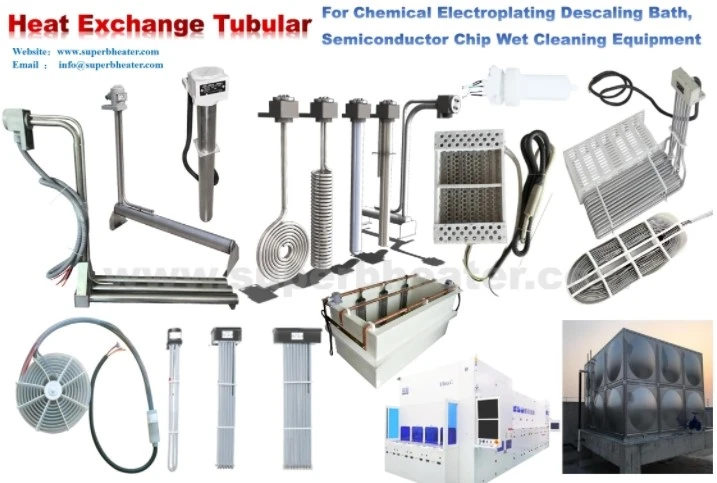
In a chemical processing tank, increasing heating power is not always the best way to improve heating performance. When the heating surface is small, a large amount of electrical energy is concentrated into a limited area. The bath may heat quickly near the plate while distant regions remain relatively cool.
This is where heating plate surface area becomes important. Surface area affects heat flux, temperature distribution, circulation requirements, and the ability of the process liquid to absorb heat efficiently.
The main engineering trade-off is between heating intensity and thermal uniformity.
Surface Area Directly Changes Heat Flux
Heating plate surface heat flux can be expressed as:
q″ = Q/A
where Q is heating power and A is effective heating surface area.
For a fixed heating power, increasing surface area reduces heat flux.
For example, a 12 kW heating system concentrated over a small surface produces a much higher local thermal load than the same 12 kW distributed over a substantially larger heating area.
Lower heat flux generally reduces the temperature difference between the heating surface and the surrounding chemical liquid.
This can improve thermal stability when circulation is adequate.
Why High Heat Flux Can Reduce Heating Efficiency
A high heat flux may appear beneficial because the heating plate becomes hotter and transfers energy rapidly.
However, the liquid surrounding the plate must also be capable of removing that heat.
A simplified relationship is:
Q = hAΔT
where h is the effective heat-transfer coefficient and ΔT is the temperature difference between the heating surface and liquid.
If circulation is weak, the liquid near the heating plate can become significantly hotter than the bulk solution. Increasing power may then increase local temperature more than it increases useful heating of the entire bath.
The result can be poor temperature uniformity despite high installed capacity.
Larger Surface Area Can Improve Thermal Distribution
Increasing heating plate area spreads the thermal load across a larger contact surface.
This can be particularly useful in:
Plating tanks
PCB wet-processing tanks
Chemical cleaning systems
Surface-treatment baths
Wet metallurgy tanks
A larger heating surface can introduce heat over a broader region, reducing the distance that thermal energy must travel through the liquid.
In long or shallow tanks, this can be more effective than using one compact high-power heating plate.
Surface Area Must Match Tank Geometry
Increasing area is not simply a matter of making the plate larger.
The available tank footprint, liquid depth, internal structures, circulation direction, and maintenance clearance all influence the useful heating area.
A large plate installed against a tank wall may have poor circulation around part of its surface. Another large plate installed too close to the bottom may create a restricted flow region.
The effective heating area is therefore the portion of the surface that can actually transfer heat into circulating process liquid under normal operating conditions.
| Heating plate configuration | Surface area | Heat flux at equal power | Temperature distribution | Typical application |
|---|---|---|---|---|
| Compact high-power plate | Small | High | More localized | Small tanks |
| Moderate-area plate | Medium | Moderate | Balanced | General chemical heating |
| Large-area plate | Large | Low | More distributed | Large process tanks |
| Multiple distributed plates | Large total area | Low to moderate | Highly distributed | Long or irregular tanks |
The table shows why heating plate dimensions should be evaluated together with power rather than specified independently.
Circulation Determines the Benefit of More Area
A larger heating surface cannot compensate completely for extremely poor circulation.
If the chemical solution remains nearly stagnant, even a large heating plate can develop a warm boundary layer.
Forced circulation can improve this condition by continuously moving cooler liquid toward the heating surface and transporting heated liquid into the bulk tank.
For high-viscosity solutions, circulation becomes even more important because natural convection is weaker.
The most effective design therefore combines appropriate heating area with sufficient liquid movement.
PTFE Heating Plates Require Area Planning
For corrosive chemical applications, a PTFE heating plate may be selected because of its chemical resistance.
PTFE has relatively low thermal conductivity compared with common metals. This means heat generated inside the plate must be distributed carefully before reaching the chemical solution.
A larger active surface can help distribute the thermal load, but heating-element layout, plate thickness, and power density must also be considered.
A large PTFE plate with poorly distributed internal heating elements may still experience localized temperature differences.
More Area Does Not Always Mean Better Efficiency
Excessive heating area can also create disadvantages.
A very large plate may increase material usage, installation difficulty, and equipment cost without providing meaningful thermal improvement.
If total heating power remains unchanged while surface area becomes excessively large, heat flux can become so low that temperature recovery takes too long.
The appropriate surface area therefore depends on the required heating rate.
For continuous production, a moderate heat flux may be preferred. For intermittent production, additional heating zones may provide a more flexible solution than simply enlarging the entire heating surface.
Surface Area Should Be Selected With Power
A reliable heating plate design considers the relationship between:
Total power + active heating area + heat flux + circulation + tank geometry
For example, increasing power from 10 kW to 20 kW without increasing the heating area approximately doubles the surface heat flux. Increasing the heating area at the same time can maintain a more moderate thermal load.
This is often a more practical approach for large chemical tanks where temperature uniformity is important.
The Most Efficient Area Is the One the Process Can Use
Heating plate surface area affects chemical bath heating efficiency because it determines how electrical power is distributed across the heating interface.
Too little area can create high heat flux, local overheating, and unstable temperature control. Excessive area can increase equipment size without improving heating speed.
For a custom or replacement heating plate, tank dimensions, bath volume, chemical concentration, target temperature, circulation rate, required heating time, available installation space, and acceptable heat flux should be evaluated together.
The best heating surface is therefore not simply the largest possible area. It is the area that allows the required power to enter the chemical bath efficiently, uniformly, and with controlled thermal stress.