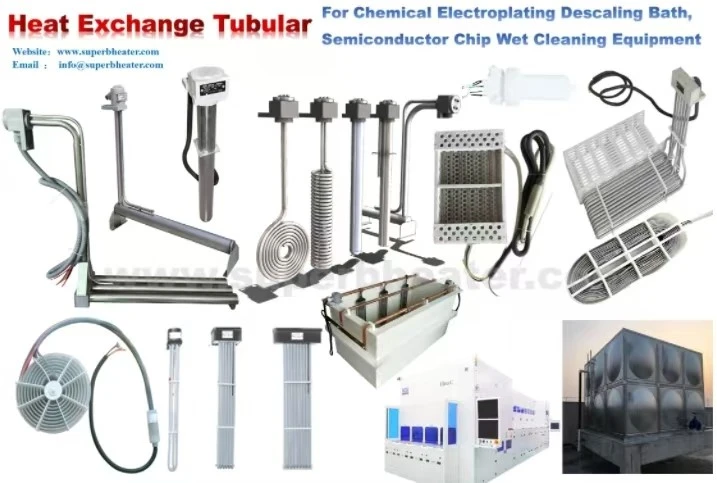
Titanium heating equipment usually consists of submerged heating tube sections inside reaction tanks and exposed wiring terminals extending outside vessel walls. In humid chemical and biotech workshops filled with acidic mist, saline vapor and volatile organic solvents, the bare metal terminals directly contact airborne corrosive substances. Temperature differences between high-temperature internal heating components and ambient cold air lead to continuous condensation on terminal surfaces, dissolving floating salt particles and acidic droplets in the air. Repeated evaporation and condensation cycles trigger salt crystal precipitation and accumulation, gradually eroding the titanium passive film and inducing local crystallization corrosion at the junction between immersed tube segments and exposed terminals. Reasonable thermal insulation configuration stabilizes the surface temperature of external terminals, eliminates dew formation conditions, cuts off the formation path of concentrated corrosive salt solutions, and effectively protects titanium heating transition sections from atmospheric crystallization corrosion.
External surface temperature control via integrated thermal insulation wrapping is the core measure to avoid dew condensation on titanium heating terminals. When the surface temperature of exposed terminals drops below the ambient dew point temperature, water vapor in humid workshop air condenses into liquid droplets on metal surfaces. These droplets absorb chloride, sulfate and acidic volatile substances drifting in the atmosphere, forming dilute corrosive electrolyte solutions. As the heating equipment operates intermittently, repeated heating evaporation and ambient cooling condensation make solutes continuously enrich on local terminal surfaces, forming highly concentrated salt deposits that break down the titanium dioxide protective layer. Wrapping high-temperature resistant closed thermal insulation materials around all exposed terminal sections keeps the surface temperature consistently higher than the ambient dew point, fundamentally eliminating condensation phenomena and preventing the generation of corrosive liquid films on titanium transition positions.
Sealed anti-corrosion insulation casing matching serves as an essential supplementary configuration for terminals in heavily polluted workshops. Ordinary porous thermal insulation cotton can absorb corrosive mist and moisture from the air after long-term service, which will gradually infiltrate to the titanium terminal surface and form hidden wet corrosive environments inside the insulation layer. Fully enclosed polymer insulation shells not only achieve temperature preservation to avoid dew formation but also physically isolate titanium terminals from workshop corrosive vapor, dust and salt fog. The sealed structure prevents external pollutants from contacting the metal surface directly, stopping salt crystallization at the source. Regular inspection of casing sealing integrity ensures no cracking or aging gaps appear, avoiding local hidden condensation corrosion caused by damaged insulation structures.
Thermal bridge isolation design at the tank wall penetration position cannot be ignored in overall insulation layout. Titanium heating tubes penetrating tank walls form thermal conduction channels that transfer high internal medium temperature outward to exposed terminals. Without thermal bridge isolation gaskets at penetration points, excessive heat conduction leads to uneven temperature distribution on transition sections, creating partial low-temperature zones prone to dew condensation. Installing non-conductive thermal isolation gaskets between titanium tubes and tank wall holes weakens outward heat transfer, balances the overall surface temperature of exposed terminals, and avoids local temperature difference-induced concentrated salt deposition at penetration joints.
The following table displays targeted thermal insulation schemes for different workshop atmospheric environments:
表格
| Workshop Atmospheric Service Scenario | Recommended Terminal Thermal Insulation Configuration | Core Anti-Crystallization Corrosion Effect |
|---|---|---|
| Coastal chemical plant with heavy salt fog corrosion | Sealed polymer insulation casing + thermal bridge isolation gaskets | Blocks salt fog infiltration and eliminates dew condensation via balanced surface temperature |
| Acid volatile fine chemical production workshop | Closed dense insulation wrapping + full sealing terminal housing | Prevents acidic vapor condensation and avoids concentrated acid salt corrosion |
| Humid indoor biopharmaceutical fermentation workshop | Standard high-density thermal insulation sleeve + regular sealing inspection | Restrains dew formation and reduces organic volatile pollutant deposition |
| Dry low-pollution laboratory constant-temperature heating system | Thin-layer insulated protective cover + penetration thermal isolation gasket | Economically avoids local temperature difference condensation risks |
Thermal insulation configuration for exposed titanium heating terminals is often neglected in anti-corrosion design, yet condensation-induced salt crystallization corrosion is one of the most common failure causes at tank penetration transition positions. Titanium's excellent liquid-phase corrosion resistance cannot prevent atmospheric concentrated salt erosion caused by repeated dew cycles. Scientific insulation and sealing design eliminate the environmental conditions required for salt crystal enrichment, protect vulnerable terminal transition sections, reduce maintenance frequency for external heating components, and realize long-term stable safe operation of titanium heating systems both inside and outside industrial vessels.