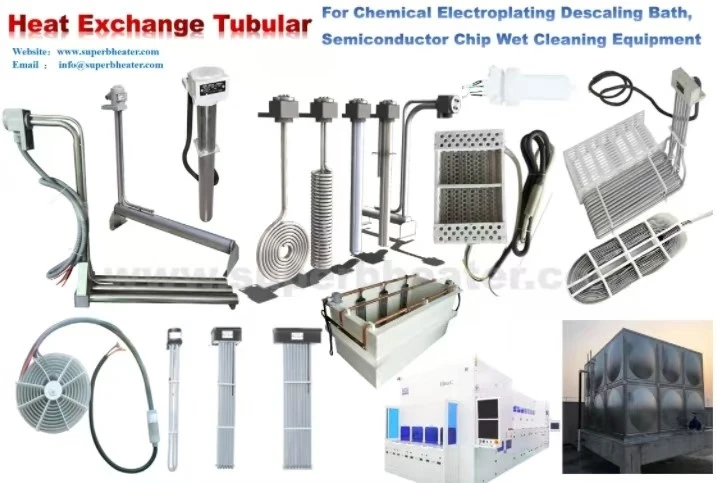
Titanium heating tubes mounted inside mechanically agitated reactors endure continuous cyclic vibration generated by high-speed rotating stirring impellers throughout long-term batch production. Residual internal stress formed during tube bending, welding and cold machining processes accumulates gradually under repeated alternating vibration loads. Stress concentration zones located at bent segments, welded joints and bracket clamping positions become vulnerable initiation points for fatigue microcracks. Once tiny cracks emerge on the titanium substrate, corrosive process fluid penetrates these defects and accelerates crack expansion via stress corrosion coupling effect, eventually causing tube rupture and medium leakage. Regular implementation of professional vibration stress relief treatment can effectively release residual forming and welding internal stress, homogenize the internal metallurgical structure of titanium components, reduce the sensitivity to vibration fatigue and stress corrosion, and significantly prolong the reliable service cycle of heating equipment under long-term stirring vibration conditions.
On-site low-frequency vibration stress relief treatment is the most applicable process for installed titanium heating assemblies that cannot be disassembled for thermal annealing. Traditional furnace stress relief requires complete removal of heating tubes from reaction tanks, which leads to lengthy production shutdown and high disassembly reinstallation costs. The portable vibration stress relief device fixes vibration exciters at multiple stress-concentrated positions such as welding joints and bent sections, applying periodic low-amplitude alternating vibration for a set duration. This process drives the internal lattice of titanium metal to produce tiny plastic slip, releasing residual tensile stress generated during cold forming and welding, and redistributes stress into a uniform low-stress state. Properly controlling vibration frequency, excitation amplitude and treatment duration avoids introducing new processing stress while achieving ideal stress relief effects, greatly lowering the risk of fatigue crack nucleation under long-term stirring cyclic vibration.
Pre-operation vibration stress relief for newly retrofitted titanium heating systems serves as the most cost-effective preventive anti-fatigue measure. Most early fatigue failures of newly installed heating tubes occur within the first one to two years of operation, mainly attributable to unreleased residual welding and bending stress superimposed with stirring dynamic vibration. Conducting vibration stress relief immediately after on-site welding, polishing and assembly eliminates high-stress regions before the equipment is officially put into production. Compared with post-failure maintenance and replacement, pre-emptive stress treatment effectively avoids hidden dangers at the source. Combined with subsequent regular periodic retreatment arrangements, it can keep the internal stress level of titanium heating components within a safe range for decades of continuous industrial operation.
Vibration stress relief must be matched with surface passive film inspection and local repassivation. The alternating vibration applied during the stress relief process may cause slight friction between heating tubes and fixed supports, resulting in partial abrasion of the titanium dioxide passive film at contact points. After each stress relief treatment, maintenance personnel need to conduct comprehensive surface inspection on clamping positions, bent sections and weld areas. For positions with passive film scratches or discoloration, local polishing and targeted chemical repassivation are required to reconstruct a complete protective oxide layer, preventing stress corrosion cracks from developing at stress-relieved high-stress zones once bare titanium substrate is exposed to corrosive media.
The following table shows matched periodic vibration stress relief schemes for different stirring operation conditions:
表格
| Agitated Vessel Service Scenario | Recommended Vibration Stress Relief Scheme | Core Fatigue & Stress Corrosion Protection Benefit |
|---|---|---|
| High-speed large-impeller strong-vibration chemical reactor | Pre-installation stress relief + annual on-site low-frequency vibration retreatment | Releases welding residual stress and suppresses fatigue crack initiation under intense cyclic vibration |
| Medium-speed biopharmaceutical fermentation stirred tank | Initial stress relief after retrofit + biennial stress detection and supplementary vibration treatment | Balances maintenance cost and effectively inhibits stress corrosion at welded joints |
| Intermittent batch low-speed stirring reaction equipment | One-time pre-operation vibration stress relief + triennial key stress point inspection | Eliminates primary forming stress and avoids long-term accumulated fatigue damage |
| High-chloride corrosive medium stirred heating system | Vibration stress relief paired with post-treatment local repassivation | Prevents passive film abrasion-induced stress corrosion crack propagation |
Periodic vibration stress relief addresses the root cause of premature failure for titanium heating tubes serving in agitated vessels: superimposed residual internal stress and cyclic dynamic vibration. Titanium's excellent corrosion resistance cannot stop fatigue cracks expanding under combined mechanical load and chemical erosion. Scientific formulation of stress relief cycles and process parameters homogenizes internal stress distribution, reduces stress corrosion sensitivity, lowers unexpected leakage and equipment scrapping risks, and maximizes the whole lifecycle economic benefit of anti-corrosion titanium heating facilities.