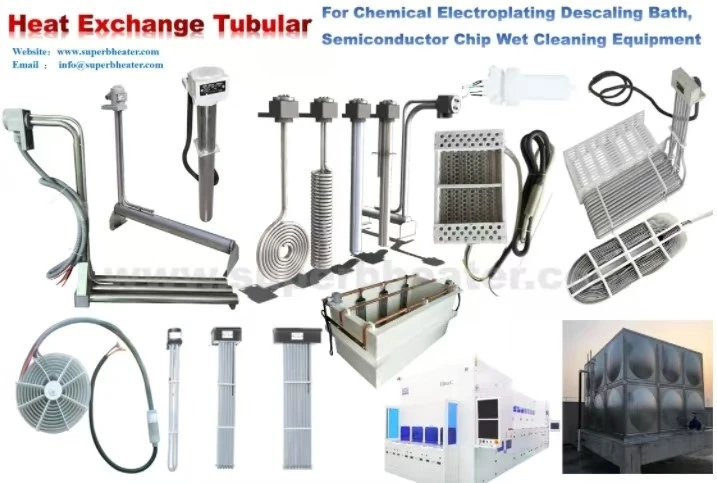
Titanium heating tubes fixed by metal brackets, clamping hoops and bolt fasteners inside agitated reaction vessels, circulating pipeline frameworks and outdoor equipment supports inevitably generate tiny reciprocating relative sliding under continuous stirring vibration, fluid turbulent pulsation, wind load oscillation and thermal expansion alternating displacement. Micro-slip between titanium surfaces and clamping accessories damages the continuous native titanium dioxide passive film at contact interfaces, exposing fresh active titanium substrates. Meanwhile, atmospheric moisture, saline mist and process medium vapor penetrate into narrow clamping gaps to form thin conductive electrolyte films, triggering fretting corrosion at contact areas. With long-term cyclic micro-friction accumulation, fretting pits gradually expand and connect into strip-shaped corrosion zones; tensile stress concentrated at these defective positions further induces stress corrosion cracking, eventually leading to heating tube clamping fracture, pipeline displacement and medium leakage accidents. Implementing scientific anti-vibration support layout design together with standardized periodic bolt fastening torque inspection can effectively reduce interfacial micro-slip amplitude, isolate direct dissimilar metal contact, maintain passive film integrity at clamping points, and eliminate fretting corrosion hidden dangers of titanium heating equipment under long-term vibration service conditions.
Optimized anti-vibration support spacing plus flexible insulating liner arrangement serves as the core technical measure to suppress fretting initiation. Excessively large support span will cause titanium heating tubes to produce large bending deflection under vibration excitation, resulting in obvious reciprocating micro-slip at each clamping point. The support interval shall be calculated according to titanium pipe outer diameter, wall thickness, medium operating pressure and environmental vibration frequency, reasonably shortening the span to reduce tube bending vibration amplitude and relative displacement between pipe and fixture. All metal clamping hoops and support contact surfaces must be lined with high-temperature resistant PTFE or fluororubber flexible insulating gaskets, which can buffer vibration impact, eliminate hard friction between dissimilar metals, block conductive electrolyte loops that induce galvanic corrosion, and avoid direct mechanical abrasion stripping of titanium passive films. For heating pipelines close to high-speed stirring impellers or large rotating equipment, anti-vibration damping supports shall be additionally arranged to absorb vibration energy and restrain resonance-induced severe micro-slip at clamping positions.
Formulated bolt torque grading control specification and regular periodic torque reinspection prevent clamping loosening-induced aggravated fretting damage. Excessively low fastening torque leads to insufficient clamping preload; tiny gaps between fixtures and titanium tubes will continuously expand under cyclic vibration, resulting in increasing micro-slip amplitude and accelerated fretting corrosion. Over-tightening bolts easily causes local indentation deformation on titanium tube surfaces, forming stress concentration points sensitive to corrosion cracking. Each specification of clamping bolts shall formulate a safe torque range based on material yield strength, gasket compression deformation limit and operating temperature creep characteristics. Quarterly on-site torque spot check and annual full-support fastening reinspection are required; once bolt torque attenuation caused by thermal creep, vibration relaxation or gasket aging is detected, retightening shall be carried out to the calibrated torque range in time. For fixtures with repeated torque loosening, damping anti-loosening washers shall be added to prevent recurrent clamping failure and progressive fretting corrosion deterioration.
Local contact anti-corrosion reinforcement paired with fretting defect non-destructive inspection builds a closed-loop protection mechanism. After long-term vibration service, disassemble partial typical clamping components regularly to inspect contact surface abrasion and fretting pitting conditions. For slight passive film scratch damage at clamping positions, local fine polishing and chemical repassivation shall be conducted to reconstruct a complete protective oxide layer; if strip fretting corrosion pits have formed, anti-vibration support reconstruction and contact surface anti-corrosion coating treatment must be implemented to avoid crack propagation under superimposed vibration tensile stress. In coastal high-salinity and high-humidity service environments, clamping assembly gaps shall be filled with neutral anti-corrosion sealing grease to block the infiltration of salt mist and condensed water, preventing the formation of electrolyte thin films inside narrow gaps and effectively slowing the development of fretting electrochemical corrosion.
The following table displays classified anti-vibration support and torque inspection protection schemes for different vibrating titanium heating service scenarios:
表格
| Vibration Service Scenario | Recommended Support Layout & Torque Inspection Specification | Core Fretting Corrosion Prevention Value |
|---|---|---|
| High-speed stirred reactor internal titanium heating coil clamping system | Optimized short-span anti-resonance support + PTFE full contact liner + quarterly bolt torque spot check | Minimizes pipe deflection micro-slip and avoids contact passive film abrasion-induced fretting pitting |
| Outdoor coastal wind-induced vibration heating pipeline support framework | Damping vibration-absorbing bracket layout + anti-loosening washer configuration + annual full fastening torque reinspection | Suppresses wind load reciprocating slip and blocks salt fog electrolyte infiltration inside clamping gaps |
| Circulating pump adjacent fluid pulsation heating pipe assembly | Reasonable support span design + graded safe torque fastening + regular partial fixture disassembly inspection | Prevents continuous pulsation-induced gradual torque relaxation and progressive fretting corrosion expansion |
| Low-speed intermittent vibration workshop indoor heating equipment | Standardized support layout + biennial torque verification + contact anti-corrosion grease sealing | Realizes economical fretting risk control and avoids long-term slow accumulated micro-friction corrosion failure |
Anti-vibration support optimization and periodic fastening torque management eliminate the two essential prerequisites of fretting corrosion: interfacial reciprocating micro-slip and dissimilar metal conductive contact electrolyte environment. Titanium's excellent bulk corrosion resistance cannot defend against local passive film continuous damage caused by cyclic micro-friction and subsequent gap electrochemical corrosion. Scientific structural vibration reduction design, standardized clamping preload control and regular contact anti-corrosion maintenance effectively restrain fretting defect initiation and expansion, prevent clamping position brittle fracture accidents, and guarantee long-term safe fixed installation and stable service of titanium heating facilities in various vibration-intensive industrial working conditions.