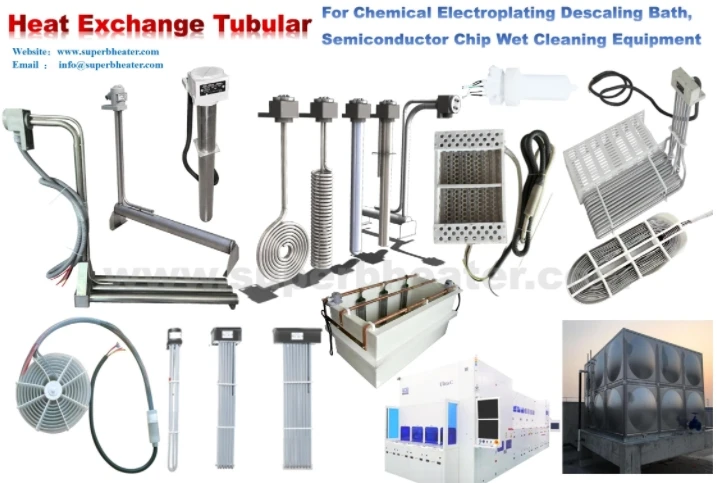
A familiar pattern develops in many heated process tanks. At commissioning, the system reaches operating temperature quickly and predictably. Months later, heat-up time gradually stretches-what once required thirty minutes now requires nearly an hour. Temperature eventually stabilizes, so the heater appears functional, yet energy usage rises and production cycles lengthen. No alarms trigger and no visible failure occurs, creating uncertainty about the source of the problem.
This situation often points to a silent efficiency loss rather than an electrical or control fault. The most common cause is scale formation on the heater surface, a fouling phenomenon that reduces heat transfer efficiency while allowing the equipment to continue operating.
Why Deposits Form Even on PTFE
PTFE immersion heaters are widely chosen because fluoropolymer surfaces resist adhesion and chemical attack. Organic contaminants, oils, and many reaction by-products struggle to stick to PTFE. However, the non-stick property does not prevent mineral precipitation from solution.
When liquids containing dissolved hardness salts are heated, their solubility changes. Calcium and magnesium bicarbonates convert into carbonates as temperature rises. Silica becomes less soluble at elevated temperature and begins to polymerize. These substances leave the liquid phase and deposit onto the hottest available surface-the heater sheath.
The heater becomes a nucleation site where minerals crystallize layer by layer. Over time, a coherent deposit forms despite the low surface energy of PTFE. The adhesion mechanism is not chemical bonding but mechanical interlocking as crystals grow and interconnect.
A common misconception is that PTFE prevents all buildup. In reality, it strongly resists organic fouling but cannot stop inorganic mineral deposits from forming under thermal conditions.
The Thermal Barrier Effect
Once deposits accumulate, performance loss begins immediately. Minerals conduct heat far more poorly than liquid. The deposit behaves as an insulating blanket surrounding the heater.
Instead of transferring energy directly into the liquid, heat must pass through the fouling layer first. To deliver the same thermal output, the heater sheath temperature rises significantly above normal operating range. The controller continues supplying power because the tank temperature remains low, creating a feedback loop of increasing operating temperature and decreasing efficiency.
In practice, a 1 mm layer of calcium scale can reduce heat transfer by 30% or more, forcing longer heating cycles and higher electrical consumption. Over time, elevated sheath temperature can also accelerate material aging even though catastrophic failure has not yet occurred.
Recognizing Fouling in Operation
Scale buildup rarely triggers immediate alarms. Detection depends on observation and trending rather than fault indicators.
The earliest sign is slower heat-up rate. Heating curves recorded during commissioning provide a valuable baseline. When the slope of the temperature rise gradually flattens without other process changes, fouling detection should begin.
Energy consumption offers another indicator. Increased electrical load per batch or per hour of operation signals declining heat transfer efficiency.
Visual inspection confirms the diagnosis. After shutdown and cooling, the heater surface may show:
White or chalky deposits typical of calcium carbonate
Gray or glassy coatings associated with silica
Brownish or layered deposits from mixed mineral sources
Localized roughness replacing the normally smooth surface
Thick crust formation in severe cases
These deposits often concentrate near the hottest region of the heater where boiling micro-layers occur at the surface.
Monitoring and Early Detection Practices
Preventive maintenance programs benefit from simple monitoring routines. Recording heat-up time per batch allows gradual changes to become obvious. Power consumption logging provides quantitative confirmation of thermal barrier formation.
Periodic visual inspection should be scheduled rather than reactive. Even partial exposure of the heater during draining offers an opportunity to observe early mineral deposits before heavy accumulation develops.
Tracking water chemistry or bath composition also helps predict scaling tendency. Hardness, alkalinity, and silica content directly influence deposition rate. Tanks with continuous evaporation or concentration cycles experience accelerated fouling because dissolved minerals accumulate over time.
Why the Heater Appears to Work Normally
One reason scaling persists unnoticed is that the heater continues producing heat. Control systems respond to liquid temperature, not heater surface temperature. As fouling increases, the controller compensates by keeping the heater energized longer.
From an operational perspective the equipment still functions, but at reduced thermal efficiency and elevated internal stress. The performance loss becomes gradual rather than abrupt, encouraging operators to attribute delays to production variation rather than equipment condition.
Final Perspective
Scale formation is a predictable physical process whenever heated liquids contain dissolved minerals. Even fluoropolymer surfaces cannot eliminate deposition entirely. The resulting thermal barrier reduces heat transfer efficiency, increases operating temperature, and extends heating time without creating immediate failure.
Early fouling detection through performance tracking and visual inspection prevents excessive energy consumption and unnecessary equipment stress. Once buildup is confirmed, attention shifts to safe removal methods that preserve the integrity of the fluoropolymer surface, requiring careful selection of cleaning techniques appropriate for PTFE materials.